

Joseph Campbell:
“Each time, there is the same problem: Do I dare?”
Reflection
Now that that the Tao Te Ching Journal is at the printer, what’s next? If the Tao is my guiding light, my compass, where does it point next? On its own, absent a real life, the Tao is interesting reading. What's harder is living it. What does a life lived in harmony with one’s inner world, with nature, with the Tao, look like lived? How does the inner work and the outer journey become one? A life lived with integrity and courage has its own costs. Simple in concept, living the Tao presents a series of real challenges, acceptance and surrender among them.
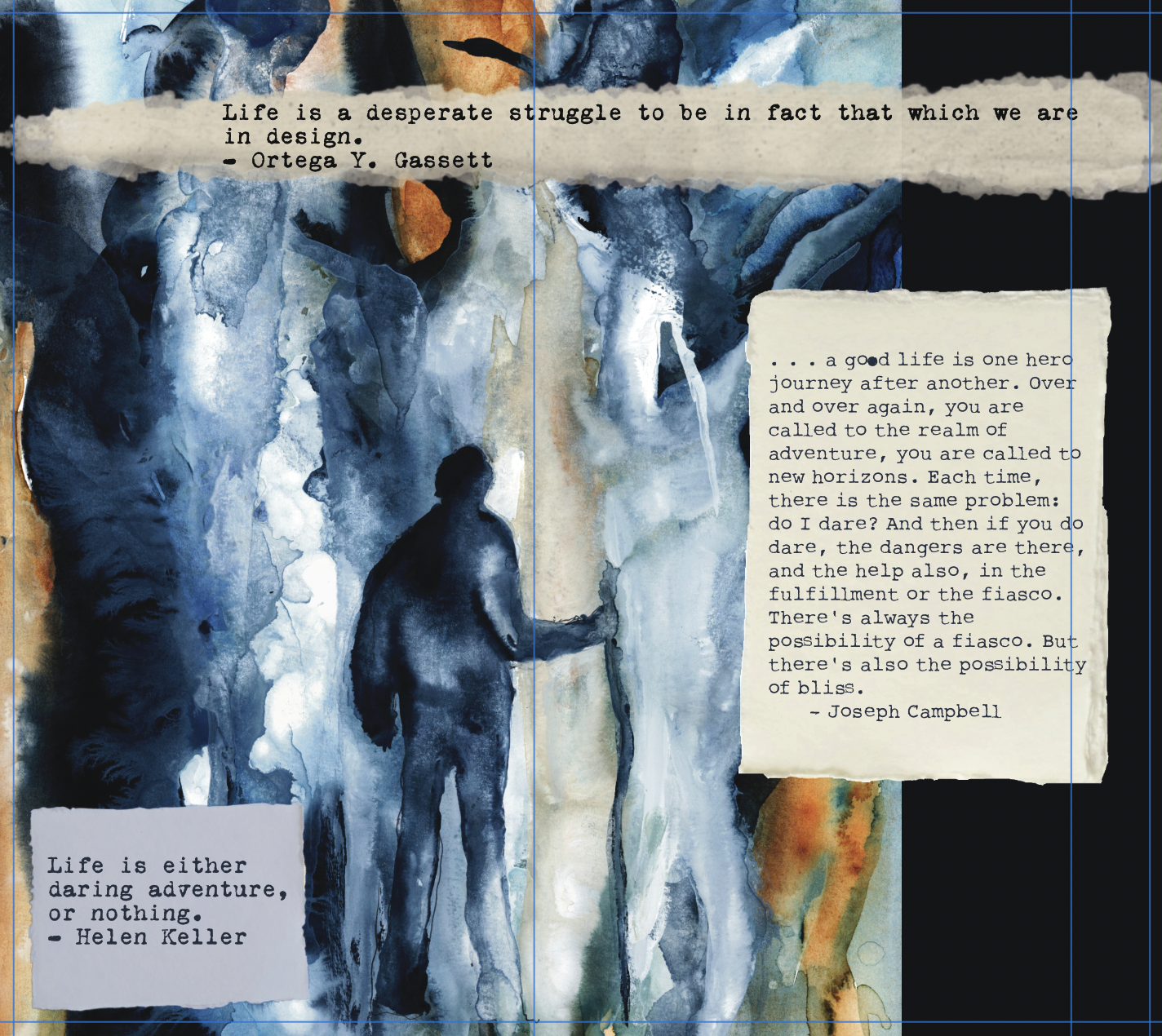
Life is a desperate struggle to be in fact that which we are in design.
- Ortega Y. Gassett
I spent much of the last week reflecting on that question. The easiest path would be to continue exploring the great Taoist and Zen poets: Han Shan, Ryokan, Basho, Li Po. Their writings are beautiful, profound, and endlessly rewarding. Yet the question that interests me most is how one lives those teachings.
What does a life look like that genuinely attempts to live the Tao? In practice, the path is often uncertain, challenging, and filled with both setbacks and progress. There are moments of clarity and moments of confusion. At times, life flows effortlessly; at others life is an upstream swim, movement in a resistant medium.
What I think is that a good life is one hero journey after another. Over and over again, you are called to the realm of adventure, you are called to new horizons. Each time, there is the same problem: do I dare? And then if you do dare, the dangers are there, and the help also, and the fulfillment or the fiasco. There's always the possibility of a fiasco. But there's also the possibility of bliss.
- Joseph Campbell, Pathways to Bliss, published after his death. (I’ve posted my favorite quotes by and about Joseph Campbell on this website here.)
Campbell was a scholar and a teacher. He grew up in an upper class family, went to private school, walked into a tenured position at Sarah Lawrence at thirty, and stayed there for thirty-eight years. He wrote movingly about the hero's journey but did not embark on one himself. Risk in the abstract is a different thing from risk lived. This isn't a criticism. The scholar's view has its value. Cartographers map mountains they haven't climbed, and the maps are still useful. But the climber's account carries something the cartographer's cannot.
Campbell’s question, Do I dare?, appears again and again when one embraces their adventure and embarks upon a journey that entails risk in the pursuit of a deep experience of life. And it constantly appears when one seeks to live a creative life according to a set of deeply held values. I’ve experienced (or created) more than my fair share of fiascos. I have also lived a life deeply connected to the beauty and mystery of wild nature. I’ve lived according to my own values, pursued dreams and visions of what my potential is, in particular my creative potential. For most of my life I have chosen uncertainty over security, self-employment over the security of a paycheck, and the pursuit of meaningful work over the promise of predictability. Whether as an artist, writer, or whitewater kayaker, I have spent much of my life exploring the outer edges of my own comfort zone. I’ve spent more than my fair share of time going down rapids upside down.
I'm not saying any of this to suggest others should take the path I took. Most shouldn't. The path is hard, and the costs are real. What I'm saying is that I know something about the territory because I've spent decades living it.
Fifty-three years ago, at the age of sixteen, I hitchhiked up into northern Canada as far as the road went – Yellowknife — and lived in the bush with Dogrib Indians who couldn’t speak English and had only a vague concept of what Canada was. A couple of years earlier, canoeing in northern Quebec, I came across abandoned Cree cabins by remote lakes and became fascinated by the lives of those people. I read everything I could about how they lived and saw life. I wanted to know how they connected with nature and with each other. I learned, living with the Dene people in the bush, that their lives are a lot different than the romanticized version on TV and in books. Living in the subarctic with stone age technology where it is dark four months a year is a spiritual adventure yes, but it is also a survival adventure. Nature is not your friend. Many people knew family members who had frozen, drowned, or starved. Survival required skill, resilience, and cooperation. And some luck. Yet alongside those hardships I encountered qualities that often seem scarce in modern culture: patience, generosity, humility, and a deep awareness of one's dependence upon others.
So where do I go from here as I strive to live the Tao, and sometimes succeed and sometimes fail? I have hundreds of stories to tell about that life. There’s the theory and then there’s the life lived. The territory where the two meet and where the two diverge contain some insights and deep, challenging learning. Real life is a lot messier than the Tao.
Life is either daring adventure, or nothing.
- Helen Keller
As a tool in this exploration, I plan to use my art journal from which the image above originated — quick, relaxed watercolor sketches accompanied by thoughts and quotes that bubble up from deeper levels of consciousness.
. . .
Soetsu Yanagi's The Unknown Craftsman
Along the way, certain books have become trusted companions. Few have influenced my thinking more about the manifestation of one’s inner life in creative work than Soetsu Yanagi's The Unknown Craftsman. It explores the ancient Zen arts and handcrafts of Asia, and the spiritual practices and philosophies that underly that work.
I’ve posted my favorite excerpts here and intend to explore the significance of the book from time to time in posts over the next few months.
. . .
Zen Buddhism resulted from the encounter between Buddhism from India and Taoism from northern China. Poetry was an important part of the tradition of the Taoist hermit monks of the Zhongnan Mountains. The Tao Te Ching is the best known of those poems but there were thousands of others written over two thousand years ago. Many are as beautiful and mysterious as the Tao.
Zen Mountain Journal also draws from the poetry of the Zen Buddhist monks of old Japan.
Zen Mountain Journal offers a Taoist journaling practice for those who seek to connect with inner worlds, with the deep silence and peace within. The poems and paintings in these posts are part of a journal now being created by Heron Dance Press. It will be available for preorder shortly.
The Zen Mountain Journal is reader supported but there is no obligation to contribute. If you would be willing to contribute, please do that here.