

Some Favorite Quotes From the Work of Bill Porter (Red Pine)
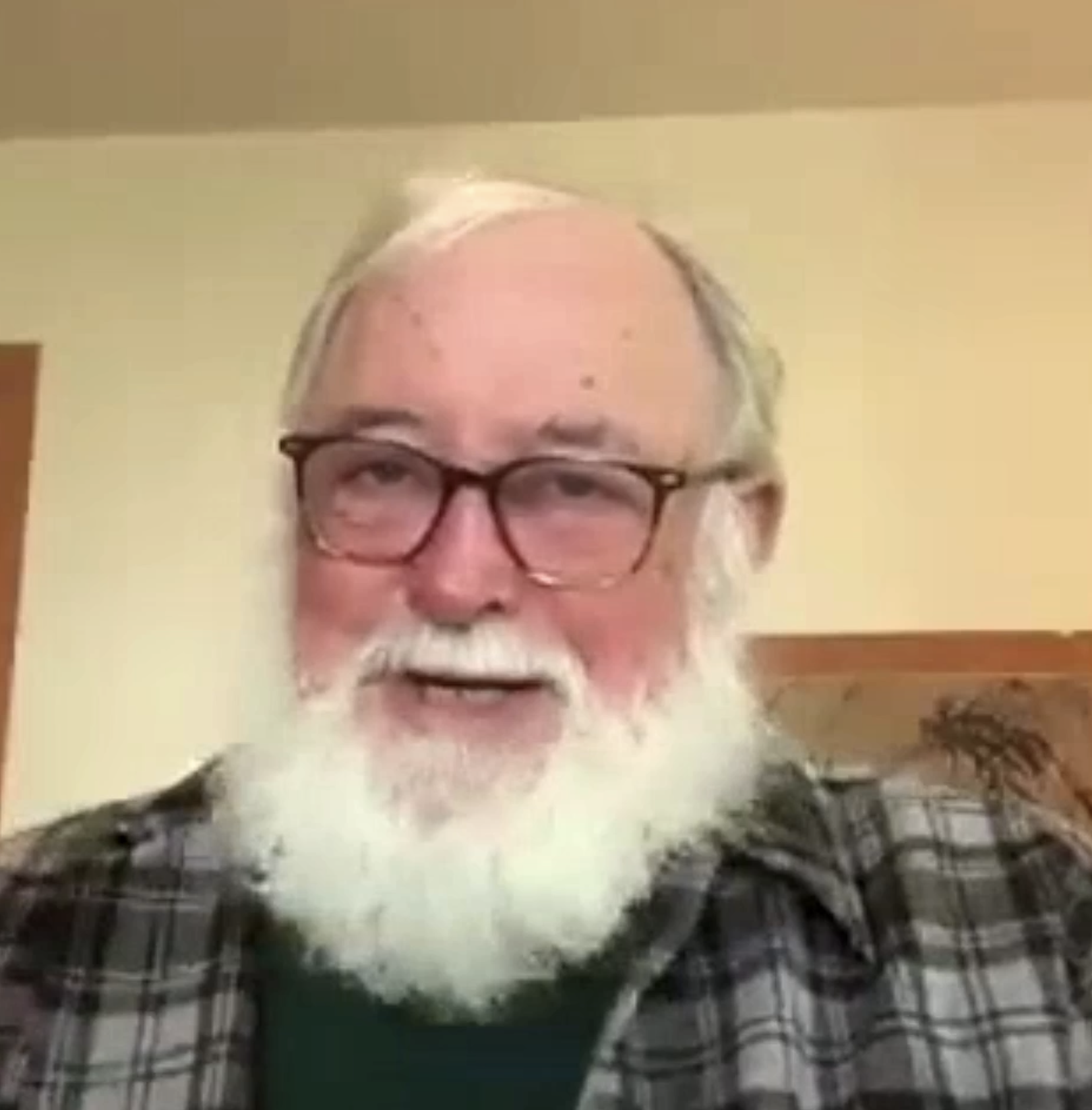
A screenshot from my interview of Bill Porter (Red Pine)
Scroll down for information on the Tao Te Ching Journal
Spring water is pure in an emerald stream
moonlight is white on Cold Mountain
silence thoughts and the spirit becomes clear
focus on emptiness and the world grows still
- Han Shan (aka Cold Mountain), 9th Century T’ang Dynasty, as interpreted by Red Pine, The Collected Songs of Cold Mountain
. . . .
Silence thoughts, invite emptiness
The universe beckons.
- journal reflection
Bill Porter interviewed Master Hsieh, a Taoist monk, living on China’s Huashan Mountain.
Hsieh: Lao-tzu said to cultivate tranquility and detachment. To be natural. To be natural means not to force things. When you act natural, you get what you need. But to know what’s natural, you have to cultivate tranquility. Huashan has long been famous as a center of Taoism because it’s quiet. There used to be a lot of hermits here. But now the mountain has been developed for tourism. The tranquility is gone, and so are the hermits.
Porter: Aren’t they interested in teaching others?
Hsieh: Yes. But before you can teach others, you have to cultivate yourself. You have to know something before you can teach something. You can’t explain inner cultivation just because you know words in books. You have to discover what they mean first.
Porter: If people can’t learn Taoism from hermits, can they learn from monks in temples?
Hsieh: You can’t learn just by visiting a temple. You have to live there for at least three years and help with the daily work. If you can stand the hardship and privation, after three years you can ask one of the monks to be your teacher. It’s not easy. You have to have a clear head and a quiet mind. As I said before, it takes at least three years of physical training before your mind is quiet enough to understand the Tao.
- from the book Road to Heaven: Encounters with Chinese Hermits, by Bill Porter
One Tiny Hut
The shade of noble trees spreads in all directions
below the trees a tiny hut is perfectly secluded
beyond the sound of cart or horse or sign of human tracks
all day behind my door I sit alone cross-legged
Clouds release the hillsides and wake the scenes of spring
where is the plum tree that wafts that subtle scent
I grab my staff intending to search secluded valleys
then find a single branch against my eastern wall
I follow my impulsive feet wherever they might go
my body is a pine tree surrounded by the snow
sometimes I simply stand beside a flowing stream
sometimes I chase a drifting cloud past another peak
Deep among ten thousand peaks I sit alone cross-legged
a solitary thought fills my empty mind
my body is the moon that lights the winter sky
in rivers and in lakes are only its reflections
- Han-shan Te-ch’ing (1546-1623), as interpreted by Red Pine, The Clouds Should Know Me By Now, Buddhist Poet Monks of China
Spring Travel
Keeping on and on,
a traveler gets farther, farther away;
dust without cease
follows a horse through the world.
A traveler’s feelings
after the sun’s rays slant --
colors of spring
in the morning mist.
The river’s flow heard
at the empty inn --
flowers just blooming
at the old palace.
I think of home
a thousand li away;
green-willow wind
stirs on the pond.
- Han-shan Te-ch’ing (1546-1623), as interpreted by Red Pine, The Clouds Should Know Me By Now, Buddhist Poet Monks of China
. . .
I think of home
A thousand miles away
A horse, a river’s flow, an empty inn
Flowers bloom
I go on, but still think of home.
- journal reflection. . .
The great masters of ancient times
Focused on the indiscernible
and penetrated the dark
you would never know them
and because you wouldn’t know them
I describe them with reluctance
they were careful as if crossing a river in winter
cautious as if worried about neighbors
reserved like a guest
ephemeral like melting ice
simple like uncarved wood
open like a valley
and murky like a puddle
but those who can be like a puddle
become clear when they’re still
and those who can be at rest
become alive when they’re roused
those who treasure this Way
don’t try to be seen
not trying to be seen
they can hide and stay hidden
Ts’ao Tao-Ch’ung (Taoist nun, Sung Dynasty, 960-1278) comments:
Although the ancient masters lived in the world, no one thought they were special.
- Chapter 15 from Lao-tsu’s Taoteching, Red Pine translation
Nothing in the world is weaker than water
but against the hard and the strong
nothing outdoes it
for nothing can change it
the soft overcomes the hard
the weak overcomes the strong
this is something everyone knows
but no one is able to practice
thus do sages declare
who accepts a country's disgrace
we call the lord of soil and grain
who accepts a country's misfortune
we call the ruler of all under Heaven
upright words sound upside down.
- Lao-Tzu, The Tao Te Ching, Chapter 78, as interpreted by Red Pine
Hsuan-Tsung (685-762, Chinese emperor, poet and calligrapher, Taoist and Zen scholar) comments:
The nature of water is to stay low, to not struggle, and to take on the shape of its container. Thus, nothing is weaker. Yet despite such weakness it can bore through rocks. Rocks, however, cannot wear down water.
Chu Ti-Huang (1885-1941, Ch'ing Dynasty official and early revolutionary, student of Buddhism and philosophy) comments:
We can alter the course and shape of water, but we can't alter its basic nature to descend, by means of which it overcomes the hardest and strongest things.
