

Parabola Magazine
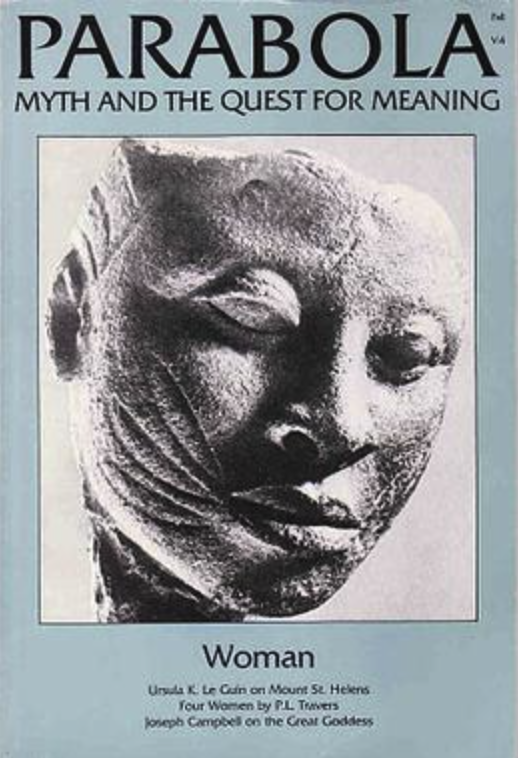
Parabola’s Spring 2025 issue was its last. It was an incredible publication. For fifty years it celebrated and explored mythology associated with the human search for meaning. Mythology is the stories we tell ourselves about who we are, about our character, about our longings, about our failures. About who we want to be. It is about the dragons we each need to slay — different for each one of us — in order to find peace.
Sampling of Parabola Back Issues
Parabola Spring 2009, Imagination, The Story Issue
Parabola, Volume 34, Number 1 (Spring 2009). This issue takes up imagination as a sacred faculty — the power that lets a shaman re-see the world, a storyteller carry a myth across centuries, and a reader be changed by a good tale. It gathers new essays alongside a collection of stories retold from traditions around the world. The full issue is available to read below as a free download.
Parabola Spring 2013: Spirit in the World Issue
Parabola, Volume 38, Number 1 (Spring 2013). This issue takes up spirit in the world — the meeting of the sacred and the everyday, and the many ways awareness is carried into ordinary life. It gathers essays, conversations, and poems from teachers and writers across traditions. The full issue is available to read below as a free download.
Joseph Campbell Interviews from Parabola
In the spring of 1976, the mythologist Joseph Campbell sat down with Lorraine Kisly — editor of Parabola and later the founding publisher of Tricycle: The Buddhist Review — for a wide-ranging conversation about how myths endure and how they are lived today. It appeared in Parabola's second issue, "Magic." Campbell was seventy-two, and speaks here on the four functions of myth, on why a Westerner cannot simply become a Hindu, on losing one's faith "without losing it," and on the inward turn he saw happening all around him.
Campbell has meant a great deal to me over the years, and this interview is one I return to. I've reproduced it here because it deserves to be read whole. You can read my favorite Joseph Campbell quotes, gathered from across his work.
Joseph Campbell on Elders and Guides (Parabola, February 1980)
In this interview, Joseph Campbell talks with Michael McKnight, then director of a Mythology Program at the University of Vermont, about the idea of age as teacher, focusing on the life and work of the great German Heinrich Zimmer, guide and elder to the young Campbell.
Buddhist Teacher Interviews from Parabola
An Interview with Tara Tulku, Rinpoche: A New Dwelling (Parabola August 1984)
In August 1984, Parabola published a conversation with Tara Tulku, Rinpoche, for its "Pilgrimage" issue (Vol. IX:3) — later collected in the anthology Leaning on the Moment under the title "A New Dwelling." The interview took place at the Amherst home of Robert A.F. Thurman, the scholar who brought Tara Tulku to the United States and who translated throughout the conversation.
Dalai Lama Interview — The Fullness of Emptiness (Parabola February 1985)
In this interview Robert Thurman asked a series of questions on the subject of "Wholeness": what it means to be a Whole Person, and how the Buddhist understanding of emptiness bears on that wholeness.