

Reflections on the Search for Inner Peace
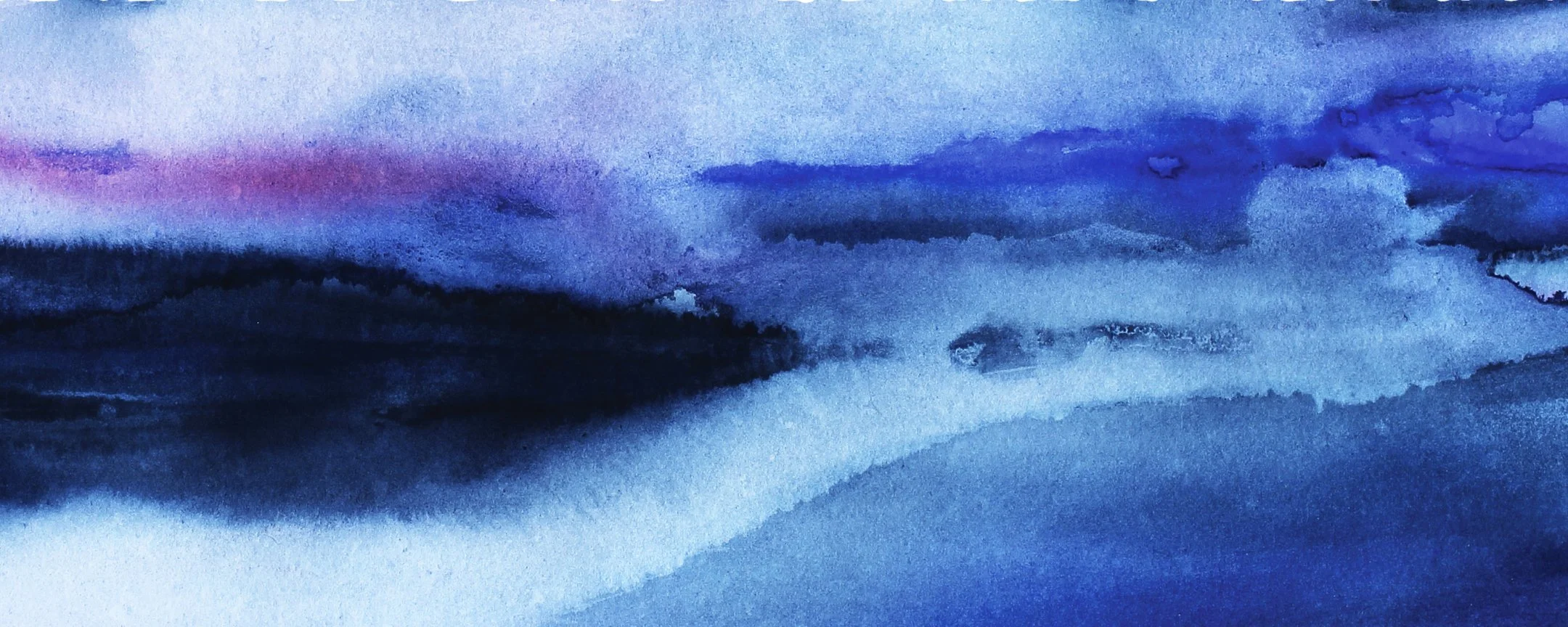
Island Abstract II: One of a series of watercolors I did after spending a summer paddling the north shore of Lake Superior solo.
Journaling, in combination with meditation, has been a big part of my life.
I first became aware of this approach to journaling from an article in a now defunct magazine, The Tarrytown Letters, given to me by a friend. He had attended a workshop offered by Dialogue House on the journaling techniques developed by Ira Progoff. One of those techniques included the use of imaginary guides — a figure who you perceive as being a person of wisdom. You then imagine meeting with that person and seeking advice from them.
I created in my mind a guide that was partly who I imagined myself to be in the closing years of my life, and partly an Indian I had met paddling by a cabin on a remote lake in northern Quebec when I was fifteen. He was quiet, thoughtful. One evening at dusk, he and I went out paddling looking for beavers and he showed me how to paddle silently. He didn’t talk much but nevertheless was friendly and seemed to understand me in a sensory sort of way.
Over the ensuing 55 years I’ve frequently turned to this figure for advice. Earlier this week I spent most of a day in meditation and then turned to this imaginary figure, and my journal, for clarity on where I next take my art and writing for this Substack and for my next book.
The advice I get from this imaginary guide often surprises me. Sometimes it offers advice that is completely contrary to what I want to do. The directions and decisions it proposes have often, in my younger years, seemed no fun. Boring even. For a while I called him Mr. Kill Joy. In retrospect though, over the years, I’ve learned that his advice could have saved me much wasted time and heartache.
The first time I asked him for advice we were sitting in his living room in front of a large window that overlooked a backcountry lake. I can’t remember the question, but I clearly remember that he got up and without a word left the room, went down to the shore, got in a canoe and paddled away. I think he was trying to tell me that the thing I was concerned about at the time was of no consequence and to ignore it.
Earlier this week I asked him where he thought I should go with my work now that the Tao Te Ching Journal is published and successful. I had been considering a number of ideas, and was more or less settled on a combination of the journaling meditation techniques described above and a revised edition of the book I published thirteen years ago, Wild Waters and the Tao. It had quickly sold out and I’ve long planned a reprint, but something about that idea gives me a vague feeling of discomfort and I was trying to figure out why.
When I asked my imaginary guide for his thoughts, his answer was unequivocal, “Write about different perspectives on the search for inner peace. Combine that with your reflections on the passages you offer readers.” I’ve often written about the search for inner peace over the years but it has never occurred to me to write about it exclusively.
I see my life as having developed along two contradictory paths. One definitely has been the search for inner peace. There have been periods of my life when I’ve submerged into inner peace, mostly on long solo canoe trips. I’ve also experienced it on long solo road trips — trips I did many times in the early years of the Heron Dance Art Journal (Zen Mountain Journal’s predecessor) when I was conducting interviews. I’d drive across the country in an old Toyota Previa van, and sleep in the back.
The other path has been one of striving and competition — working on Wall Street, amateur boxing and judo, whitewater kayaking, running a business, growing a business. Those two paths, as you can imagine, are contradictory. Walt Whitman wrote:
Do I contradict myself?
Very well then I contradict myself,
(I am large, I contain multitudes.)
I too contain multitudes, so much so that sometimes I wonder who I am. As Bob Dylan once said to an interviewer:
I change during the course of a day. I wake and I’m one person, and when I go to sleep I know for certain I’m somebody else.
As I probed my guide for his reasoning, he responded, “The thing I most want to achieve in my life, one month short of seventy years old, is inner peace. Inner peace as a daily state of mind rather than an on again off again experience.” And, he said, “You have done hundreds of interviews and accumulated thousands of quotes from books, many of which explore different perspectives on the search for inner peace. You have a lot to draw on. In particular, you’ve been engaged in a multi-year study of the poetry of ancient Zen and Taoist hermit monks.” In their search for inner peace they sacrificed almost everything in the way of comfort and family life to live solitary lives in nature, focused on their inner life, in the remote Zhongnan mountains of China.
Thinking this over, I shared the idea with a writer friend I turn to when something I’ve written concerns me, often because it is personal and revealing. He suggested building the new home page of the Zen Mountain Journal website around an interview I did more than thirty years ago, in the years before Heron Dance. His suggestion sent me back to the transcript.
In Colorado, I interviewed Jeff Casebolt, then a Colorado Outward Bound instructor, who had traveled the entire west coast of North and South America — kayaking from Alaska to just north of Vancouver and then, from there, cycling to Tierra del Fuego at the tip of South America. Jeff opened the interview by probing my motivations: was this book about thrill-seeking adventure, or about the deeper questions surrounding what it means to live a spiritual life, a life on your own terms? Apparently satisfied, he told me to go ahead with my questions. I wrote afterwards:
The intensity of his gaze startled me. The first thing I asked him was why he did the trip.
“It was both a physical and a spiritual journey. The word ‘spiritual’ has a lot of negative trappings associated with it, but I think all of us are on an inward journey. On the trip, people kept asking me why I was doing it, and the answer always changed. The picture changes. I am realizing, more and more, that it really was something that I was looking for internally. The external was certainly an incredible adventure, but it is more and more clear to me that we are all looking for inner peace.
That two and a half years is something I will carry with me for the rest of my life. It’s like a metaphor. Life is a journey. It’s an external journey and an internal journey. My desire now for a spiritual depth and awareness of a presence in my life is a result of the trip. Having encountered some really amazing people — encountered highs and lows — that I could never have accessed within myself. The trip was a glacier that gouged internally. Gouged my soul. The marks are indelibly inscribed in my soul. Meeting people who had nothing, who would take the shirt off their back to help me — taught me just how greedy we are. How people who have lots of money and lots of resources don’t know how to be generous. People who have nothing but who have a real connection with themselves and with their family and with community realize that life is really about people and love. The kind of connection and love that we can create and give each other.”
I asked him to explore that further. It has been my impression that very few are actually searching for inner peace, and in fact, if more people were on that search, the world would be a much different place. He answered:
“I think a lot of people are not conscious of what they are looking for, they couldn’t articulate it, or even think about it. But yes, I think everybody is searching for an inner kind of place that is more peaceful.”
Thirty years later, I still think about Jeff’s answer.
So that is where this Substack is going: different perspectives on the search for inner peace — the ancient hermit poets, Thoreau and Thomas Merton, Thich Nhat Hanh, Pema Chödrön and the people — the free spirits — I’ve interviewed over the years — combined with my reflections and paintings.
The mountain hermits talk about wu wei — the art of effortless flow. The quest for inner peace carries within itself an inherent contradiction. What you reach for cannot be captured. It is perpetually just beyond your grasp. It is shy, timid. So instead of reaching, you sit down and wait. Inner peace comes to you at its own pace, on its own terms. In silence. You rest your mind. You remain receptive: watching, listening, accepting. You exist inside a quiet awareness.
I’ll close with a quote by U Thant, the third Secretary General of the United Nations. He was from Burma (now Myanmar) and was a Buddhist.
Through meditation I seek inner peace. I heartily agree with Father Dominique Georges Pire, winner of the Nobel Peace Prize, when he says: "I still think that to be a peacemaker, that is to say a man of peace, one must first be at peace with oneself. One must first achieve inner peace. This involves getting to know oneself and learning to control one's impulses. Only then can a peaceful being approach the immense task of creating harmony between groups and between individuals."
- View From The U.N., The Memoirs of U Thant
There will be more from U Thant in the days ahead.