

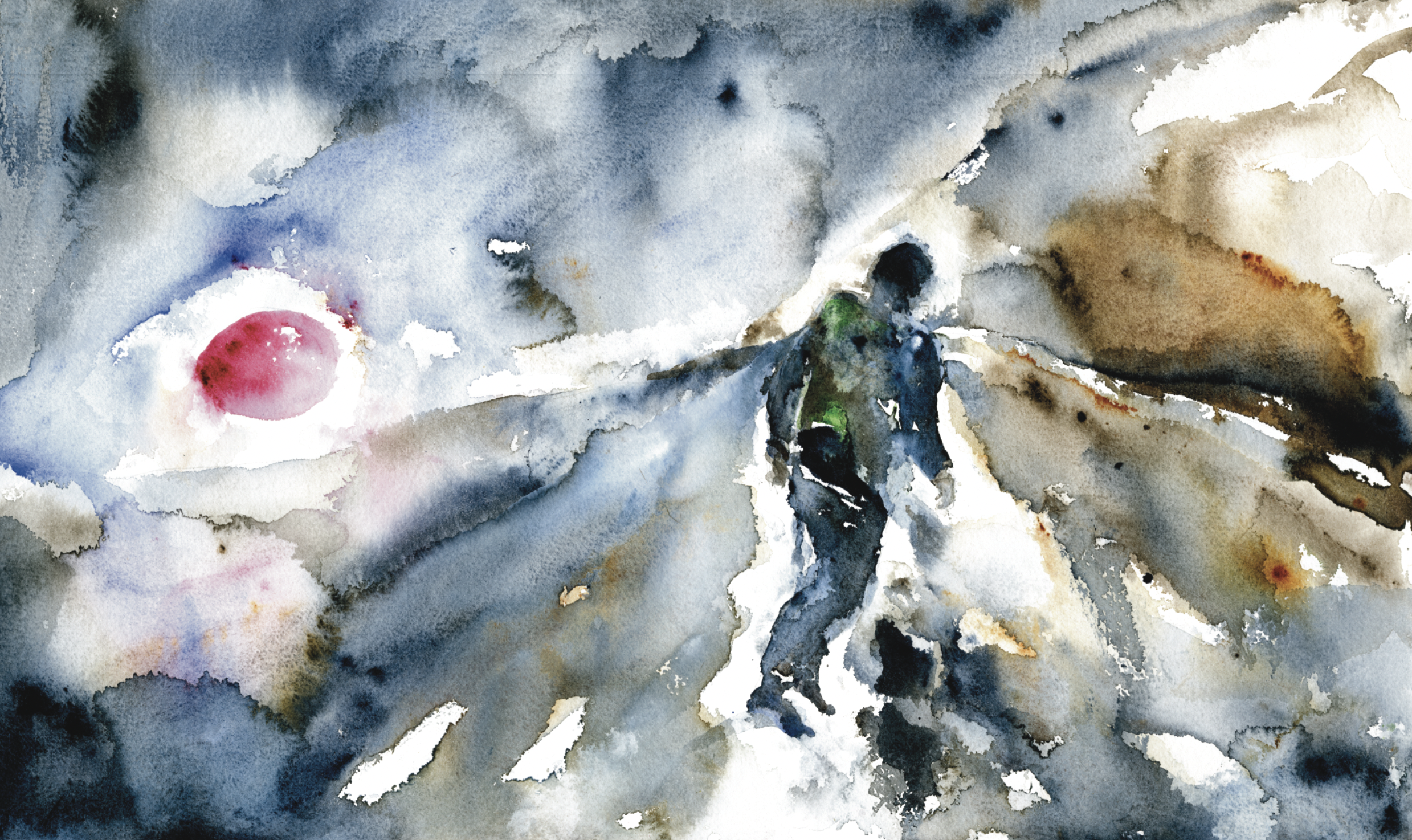
Bashō, Patron Saint of Wayward Wanderers.
Bashō (1644-1694) is the haiku patron saint of travelers and wayward wanderers. Years ago I put together a book arts collection of my poems and art and named it, “The Journey Itself Is Home”, a title taken from the opening lines of Bashō’s Oku no Hosomichi ("The Narrow Road to the Deep North"), Basho's travel journal from his 1689 journey through northern Japan.
The moon and sun are travelers through eternity. Even the years wander on. Whether drifting through life on a boat or climbing toward old age leading a horse, each day is a journey, and the journey itself is home.
- Basho
Sampu, a wealthy merchant and admirer of Bashō’s haiku, built him a small house in Edo. It burned down a couple of years later in a fire that swept through town. He lived for a while with someone he had studied Zen with at the Chōkeiji Temple in Edo, Rokuso Gohei. He found himself constantly dreaming of the open road, and decided to, as he put it, cast himself away, restore his true identity (which he described as the ‘everlasting self which is poetry’) and hit the road. Bashō wrote, “I left my broken house on the River Sumida in the August of the first year of Jyokyo among the wails of the autumn wind.”
Bashō was inspired in his travels by the example of a priest from bygone days, probably Saigyō (1118–1190) who is said to have travelled thousands of miles “caring naught for his provisions and attaining the state of sheer ecstasy under the pure beams of the moon.” Basho wrote, "I leaned on the staff of an ancient who, it is said, entered into nothingness under the midnight moon."
In The Narrow Road to the Deep North, Bashō wrote:
Days and months are the travelers of eternity. So are the years that pass by . . . I myself have been tempted for a long time by the cloud-moving wind –- filled with a strong desire to wander . . . I walked through mists and clouds, breathing the thin air of high altitudes and stepping on slippery ice and snow, till at last through a gateway of clouds, as it seemed, to the very paths of the sun and moon. I reached the summit, completely out of breath and nearly frozen to death. Presently the sun went down and the moon rose glistening in the sky.
- Basho, The Narrow Road to the Deep North. . .
Where am I on Basho’s narrow road?
Bashō left his broken house and walked into the autumn wind to recover what he called his everlasting self. Most of us won't cast ourselves away onto the open road. But the road is there regardless — we are on it whether we notice or not. The seasons of a life arrive the way weather arrives on a long walk: gradually, unannounced, and we may travel a long while inside a new one before we recognize it.So, a question to carry into stillness: Where am I now in my life?
Find a quiet place. Close your eyes. Let your breathing slow. Don't think about your life — thinking only retrieves the story you already tell, worn smooth by repetition. Let the question settle beneath thought, and let something answer for you: an image, a metaphor, a single unexpected word. This stretch of the road has been like... mist on a mountain path. A gateway of clouds. A long walk without trees. It doesn't need to make sense.
Whatever comes, write it down without judgment. Don't welcome the hopeful image or turn from the dark one. The image is not a verdict — it's a reading of where you actually stand, and where you stand is the only place a journey can continue from.
Then ask: when did this chapter of your life begin? Was there a moment — an event, a departure, a loss, a fire? Jot down what you remember. Brief entries, facts and memories, not explanations.
Finally, at least for now, write down what first comes to mind about the possible significance of that first image or thought that came to mind when you asked for something, however vague, that summarized this time of your life.
. . .
The journaling explorations in this series are inspired byIra Progoff's At a Journal Workshop, the book I'd point you to first if you want to go deeper.
Other Buddhist and Taoist pages on our website that may be of interest.