

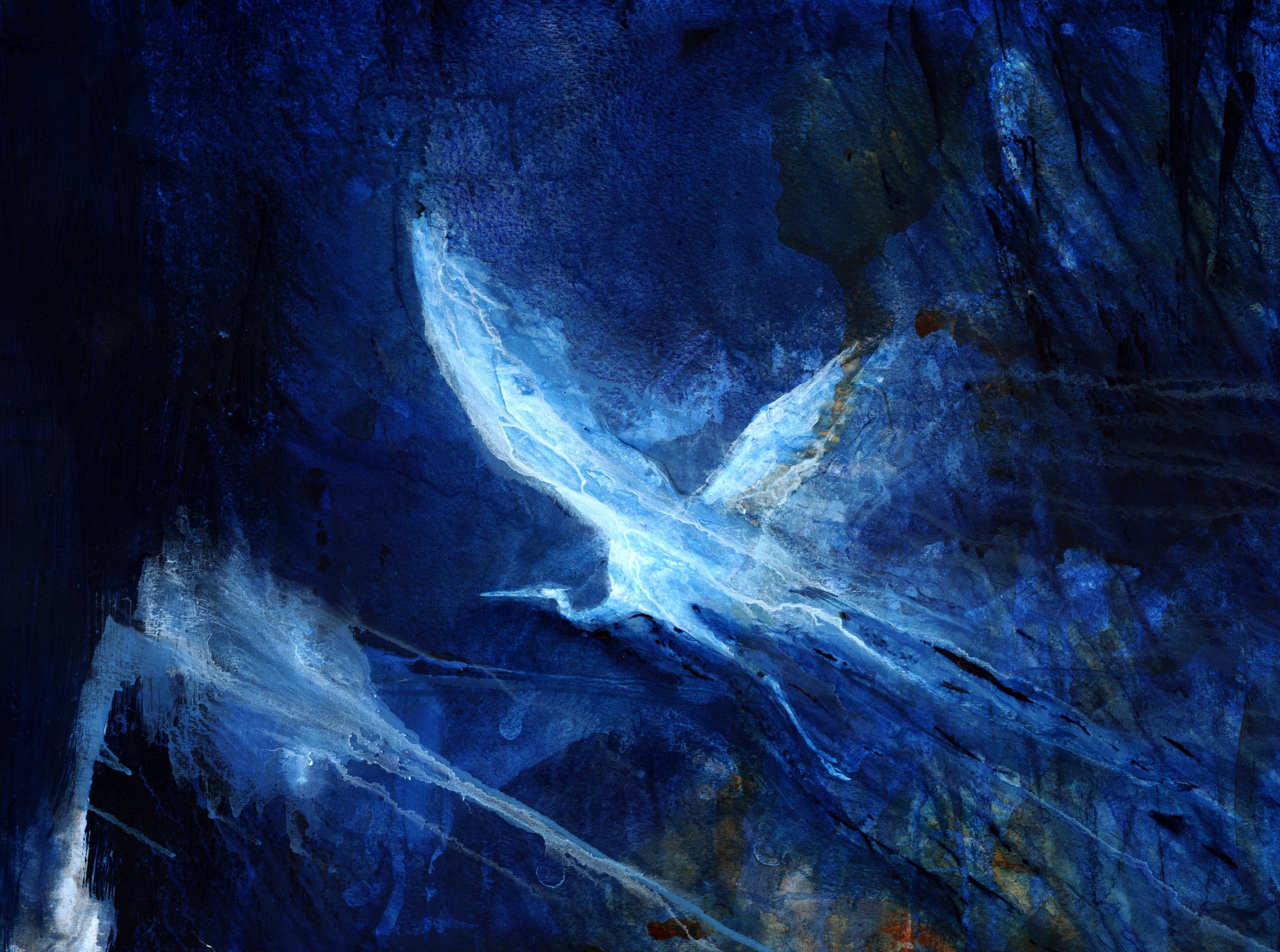
Robinson Jeffers: From source to sea-mouth one flowing life.
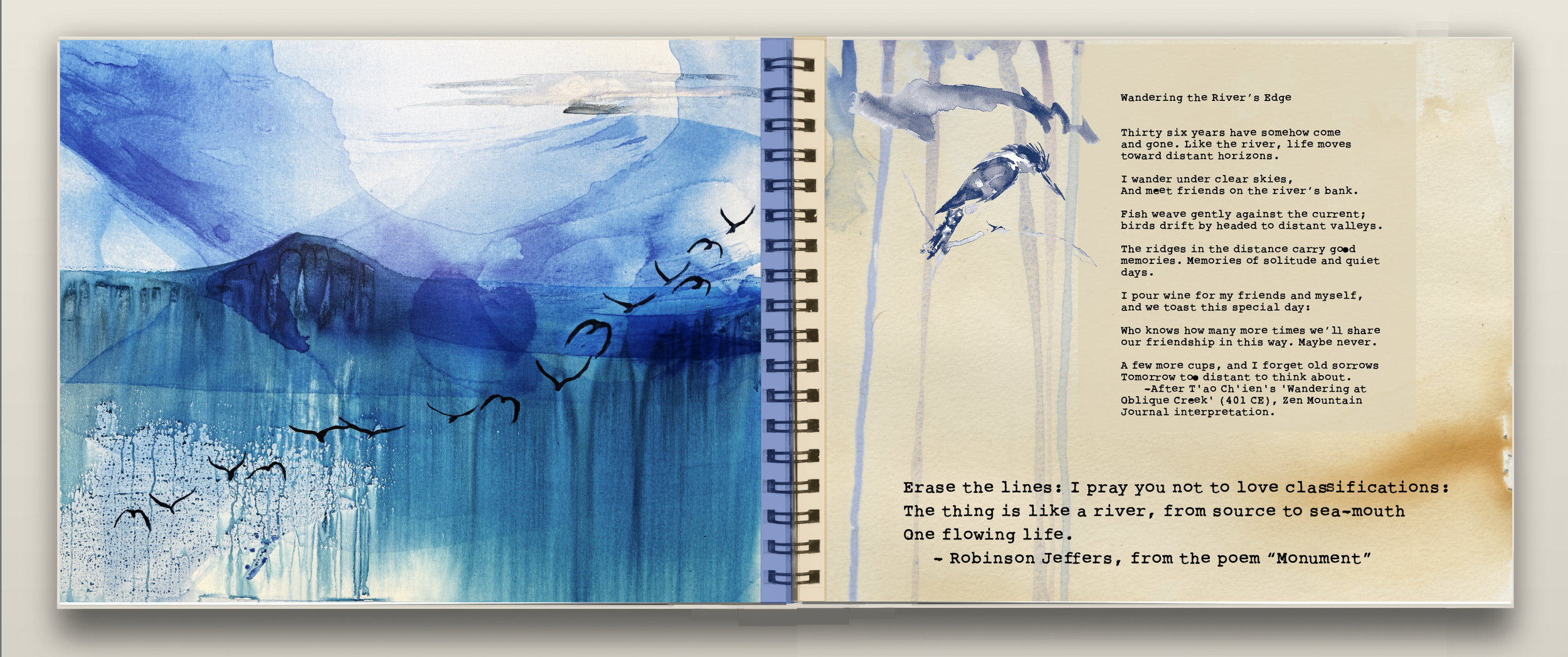
Contemplative Watercolor Experiments
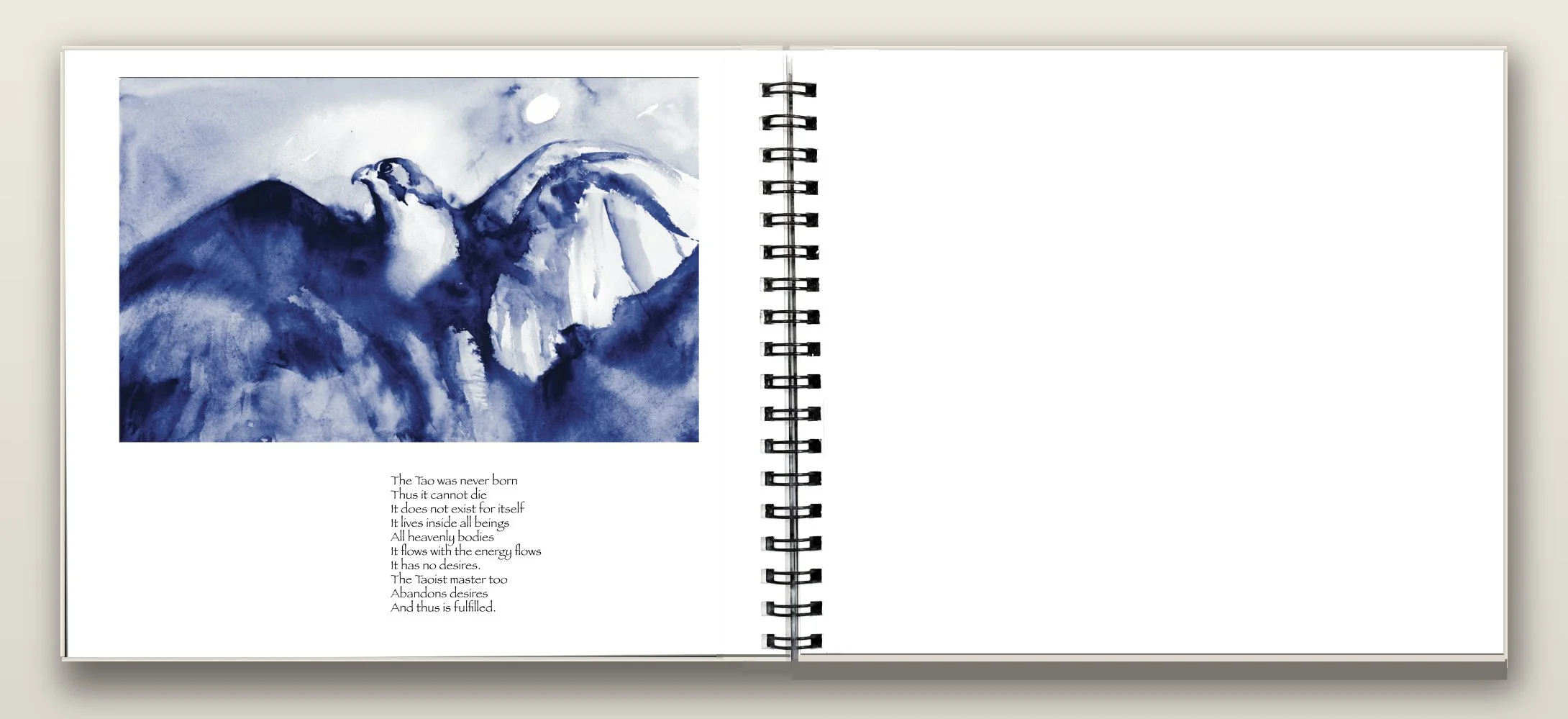
I’ve been deep into studying Picasso’s journals of preliminary sketches lately, and been experimenting with my own rough, quick watercolors and acrylic ink paintings. Inspired by the ancient poetry of the mountain hermits that means to much to me, these quickly executed paintings are abstract and Zen-like in their simplicity. I will begin to include them here in the Zen Mountain Journal — preliminary creative ideas from the outer peripheries of my vision. The idea is to plumb the depths of deep imagination, so to speak, and see what bubbles up.
These posts will continue to include, as did today’s, the ancient poetry of Taoist hermits and Zen monks of old Japan. I’ll also include recent notes from my own journal which are selected from what I’m reading, thinking about, struggling with.
When I look at the two-page spread above the concept of a a new journal comes to mind. The image on the left accompanied by a blank page on the right for reader notes and sketches. And then moving the words and images on the right to the next two pages — images and words on the left and a blank page on the right. I’m going to start to work on that.
The Tao Te Ching Journal: Updates and Reviews
The first printing of the Tao Te Ching sold out. More paper arrived at the printer today for a second printing and there will be more journals in about a week.
Some readers have taken the time to write and offer their reaction to the work. You can see those early reviews here.
You can order the hardcover layflat journal here. $67. Shipping $3.99
Members ship free.
Order the PDF of the Tao Te Ching Journal here. ($9.99)
. . .
The text from today’s post:
Wandering the River’s Edge
Now thirty-six years have somehow flowed by.
Time passes and disappears; all there is is today.I wander under clear skies,
And meet up with friends and sit on the river’s bank.Fish weave gently against the current;
birds drift by headed to distant valleys.The ridges in the distance carry memories
Of solitude and quiet days.I pour wine for my friends and myself,
and we toast this special day:Who knows how many times we’ll share
our friendship again in this way. Maybe never.A few more cups, and
I forget old sorrows
Tomorrow too distant to think about.
-After T’ao Ch’ien’s ‘Wandering at Oblique Creek’ (401 CE), Zen Mountain Journal interpretation.. . .
Erase the lines: I pray you not to love classifications:
The thing is like a river, from source to sea-mouth
One flowing life.
- Robinson Jeffers, from the poem “Monument”. . .
Reflection
Rivers have long captured my imagination and I’ve spent many weeks and months of my life paddling them, both on long wilderness trips and whitewater kayaking. That interest, and my interest in ancient Taoist poetry, was what inspired me to create the book Wild Waters and Tao, which I published in 2013 and which quickly sold out. I’m thinking through now what a sequel might look like.
Before Heron Dance was Heron Dance it was a book that couldn’t find a publisher. The working title of that book was Free Spirits and it included excerpts from my interview of Verlen Kruger who paddled more miles than anyone else ever has in recorded history — over 100,000 miles. His trips included the entire length of the Pacific coast of the US and Canada, the Grand Canyon upstream and the Amazon upstream.
Here’s an excerpt from that interview:
A river is life. A river attracts life. Rivers are always changing -- the water constantly changes, the wildlife changes. Rivers are movement, life, growth. The rivers are the arteries of the earth. They are what transfers life. Wildlife is attracted. People are attracted. Civilizations grow along waterways.
A river comes from somewhere and it goes somewhere. Where does it go? Can I go along? I cannot look at a river without wondering where the water is going. Ultimately it goes where all good waters go -- to the great sea beyond.
Sitting by a wild river, just listening can be a deeply spiritual experience. Something deep inside us resonates with wild water.
A close friend from my twenties has MS and spends much of his day sending his friends interesting things he finds on the internet. Knowing of my interest in indigenous peoples, emailed me recently about a book he’s reading, Empire of the Summer Moon: Quanah Parker and the Rise and Fall of the Comanches, the Most Powerful Indian Tribe in American History by S. C. Gwynne. He included in the email some images of paintings that were actually of the Mandan by George Catlin — an artist financed by J.P. Morgan to document the last days of the plains Indians.
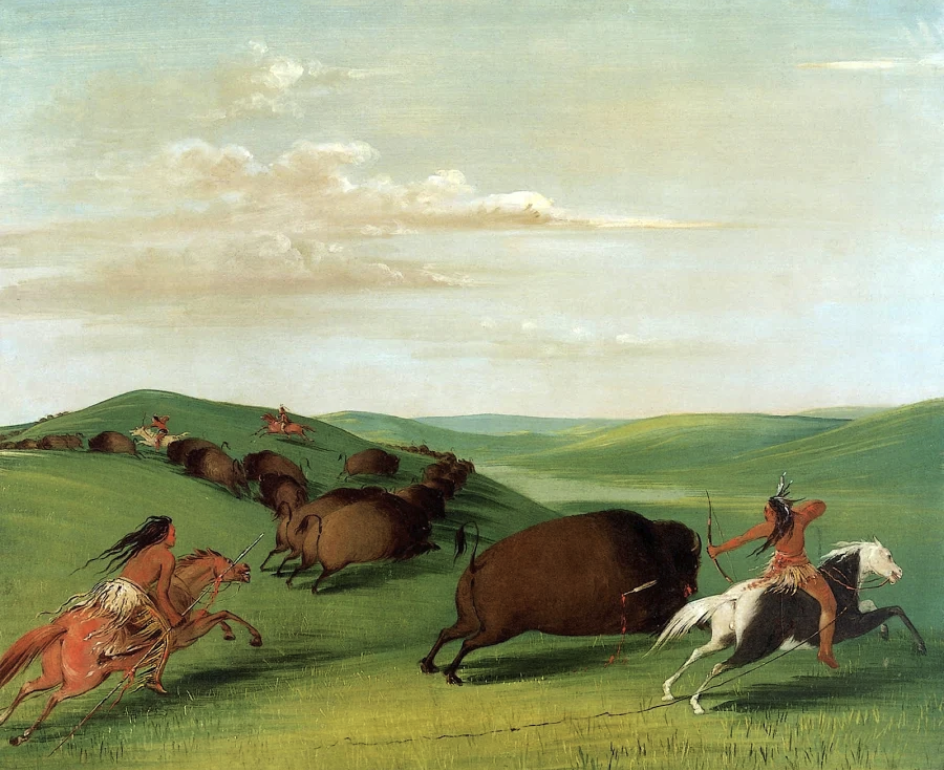
That brought to mind some excerpts I had recorded in my journal twenty or thirty years ago from Catlin’s journals about his time with the Mandan. In closing, I offer them here.
I love a people who have always made me welcome to the best they had...who are honest without laws, who have no jails and no poor-houses.. who never take the name of God in vain...who worship God without a Bible, and I believe God loves them also,...who are free from religious animosities...who have never raised a hand against me, or stolen my property, where there is no law to punish either...who never fought a battle with white men except on their own ground...and Oh, how I love a people who don’t live for the love of money!
...No man’s imagination, with all the aids of description that can be given to it, can ever picture the beauty and wildness of scenes that may be daily witnessed in this romantic country; of hundreds of these graceful youths, without a care to wrinkle, or a fear to disturb the full expression of pleasure and enjoyment that beams upon their faces -- their long black hair mingling with their horses’ tails, floating in the wind, while they are flying over the carpeted prairie, and dealing death with their spears and arrows, to a band of infuriated buffaloes; or their splendid procession in a war-parade, arrayed in all their gorgeous colors and trappings, moving with most exquisite grace and manly beauty, added to that bold defiance which man carries on his front, who acknowledges no superior on earth, and who is amenable to no laws except the laws of God and honor. . .
They live in a country and in communities, where it is not customary to look forward into the future with concern, for they live without incurring the expenses of life, which are absolutely necessary and unavoidable in the enlightened world; and of course their inclinations and faculties are solely directed to the enjoyment of the present day, without the sober reflections on the past or apprehensions of the future.
With minds thus unexpanded and uninfluenced by the thousand passions and ambitions of civilized life, it is easy and natural to concentrate their thoughts and their conversation upon the little and trifling occurrences of their lives. They are fond of fun and good cheer, and can laugh easily and heartily at a slight joke, of which their peculiar modes of life furnish them an inexhaustible fund, and enable them to cheer their little circle about the wigwam fire-side with endless laughter and garrulity. ...Their lives are lives of idleness and ease, and almost all their days and hours are spent in innocent amusements. Amongst a people who have no office hours to attend to -- no professions to study, and of whom but very little time is required in the chase, to supply their families with food, it would be strange if they did not practice many games and amusements, and also become exceedingly expert in them....
One has but to walk or ride about this little town and its environment for a few hours in a pleasant day, and overlook the numerous games and gambols where their notes and yelps of exultation are unceasingly vibrating in the atmosphere; or peep into their wigwams (and watch the glistening fun that’s beaming from the noses, cheeks, and chins, of the crouching, cross legged, and prostrate groups around the fire; where the pipe is passed, and jokes and anecdote, and laughter are excessive) to become convinced that it is natural to laugh and be merry. Indeed it would be strange a race of people like these, who have little else to do or relish in life, should be curtailed in that source of pleasure and amusement; and it would be also strange, if a life-time of indulgence and practice in so innocent and productive a mode of amusement, free from the cares and anxieties of business or professions, should not advance them in their modes, and enable them to draw far greater pleasure from such sources, than we in the civilized and business world can possibly feel. If the uncultivated condition of their minds curtails the number of their enjoyments: yet they are free from, and independent of, a thousand cares and jealousies, which arise from mercenary motives in the civilized world; and are yet far ahead of us (in my opinion) in the real and uninterrupted enjoyment of their simple natural faculties.
George Catlin, Letters and Notes On The Manners, Customs, and Conditions of North American Indians. Written during Eight Years Travel (1832-1839) amongst the Wildest Tribes of Indians in North America
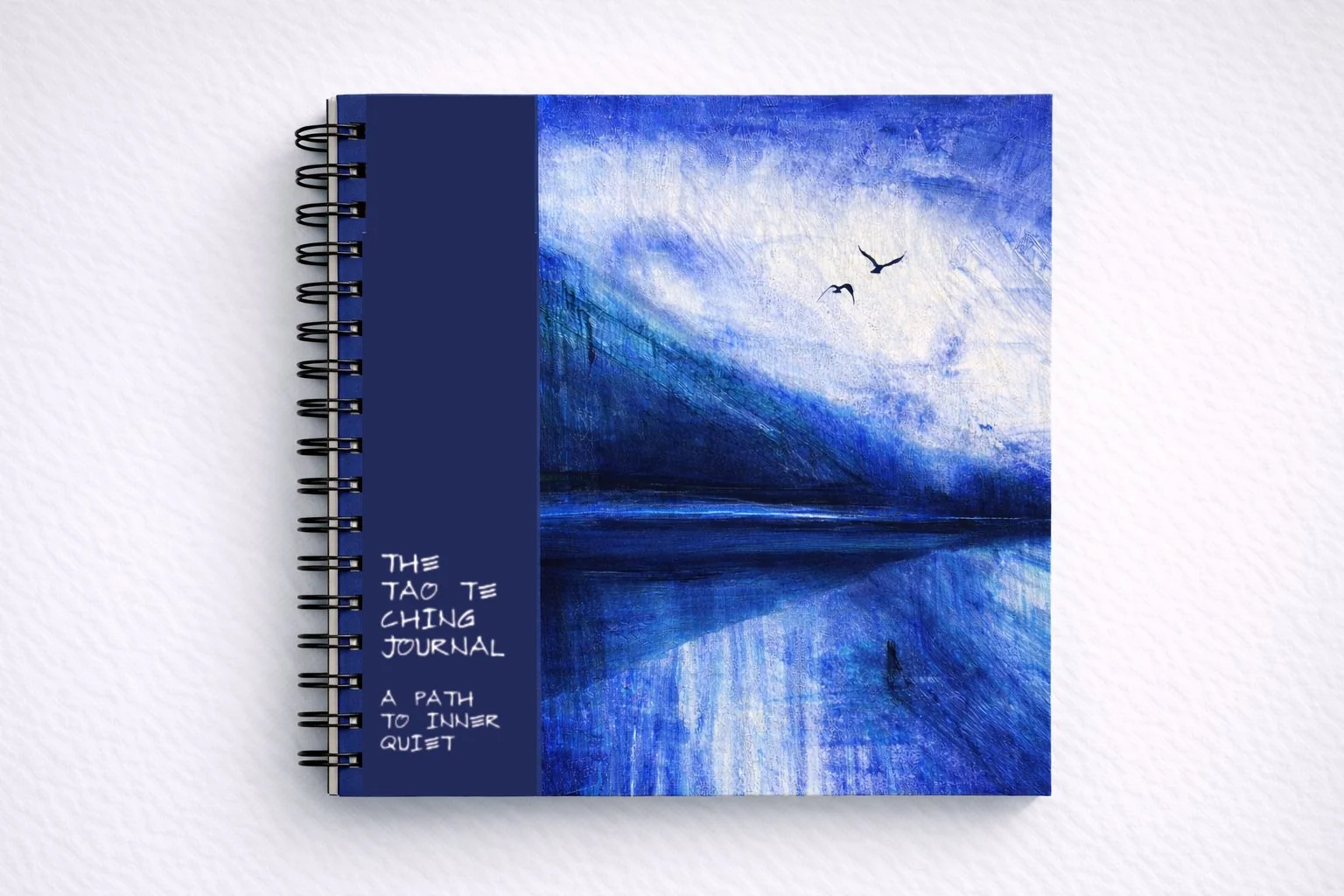

The Tao Te Ching Journal: A Path To Inner Quiet
All pre-orders receive a signed bookplate expressing the author’s appreciation for helping make this Journal possible.
Zen Mountain Journal blends Taoist hermit poetry, contemplative art, and reflections drawn from a lifetime shaped by wilderness, solitude, and decades doing creative work on the outer boundaries of our culture. These journals are companions for seekers — guides in the reconnection with inner quiet, beauty, and the “soundless music” of a life lived with simplicity and meaning.
• Size: 9.25 × 8.5 inches — convenient size for desk or lap.
• Hardcover — the book can be written in without a table or desk.
• Double wire-o bound to lay flat.
• Printed on Mohawk Superfine, a premium uncoated paper for a beautiful writing surface.
• 160 pages.
The Tao Te Ching Journal is now available for pre-order. Pre-order here. Read more here. Anticipated publication mid-June. The pre-order price is $57, after publication $67. Readers who pre-order receive copies with a signed bookplate thanking you for supporting the work and making it possible. Shipping $14.95. Supporting members are entitled to free shipping.
Everything Heron Dance does and offers is summarized here.
Zen Buddhism resulted from the encounter between Buddhism from India and Taoism from northern China. Poetry was an important part of the tradition of the Taoist hermit monks of the Zhongnan Mountains. The Tao Te Ching is the best known of those poems but there were thousands of others written over two thousand years ago. Many are as beautiful and mysterious as the Tao.
Zen Mountain Journal also draws from the poetry of the Zen Buddhist monks of old Japan.
Zen Mountain Journal offers a Taoist journaling practice for those who seek to connect with inner worlds, with the deep silence and peace within. The poems and paintings in these posts are part of a journal now being created by Heron Dance Press. It will be available for preorder shortly.
The Zen Mountain Journal is reader supported but there is no obligation to contribute. If you would be willing to contribute, please do that here.