

An Interview with Tara Tulku, Rinpoche: A New Dwelling
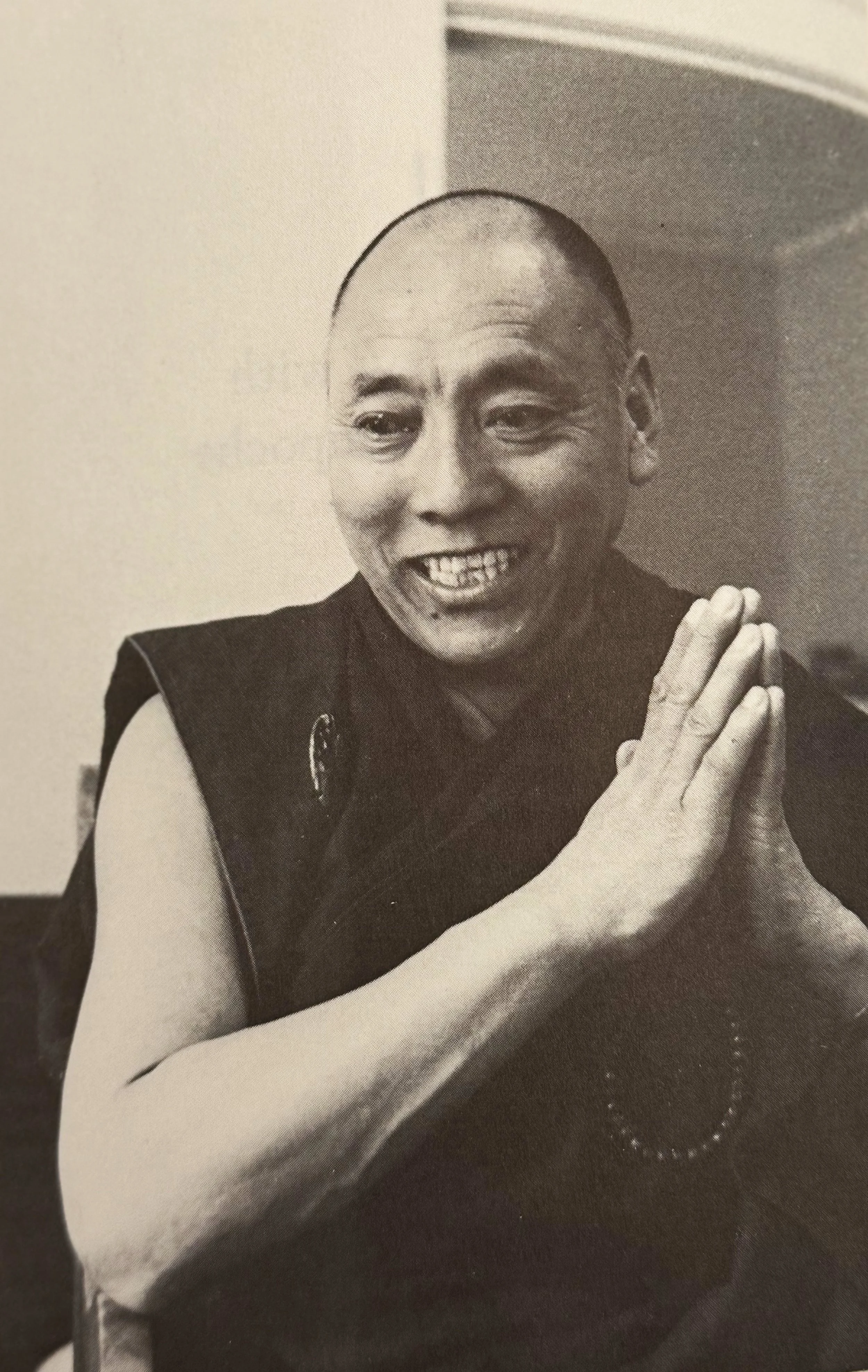
In August 1984, Parabola published a conversation with Tara Tulku, Rinpoche, for its "Pilgrimage" issue (Vol. IX:3) — later collected in the anthology Leaning on the Moment under the title "A New Dwelling." The interview took place at the Amherst home of Robert A.F. Thurman, the scholar who brought Tara Tulku to the United States and who translated throughout the conversation.
This page is a companion to the Joseph Campbell interview I've shared from the same book — Elders and Guides and the interview of the Dalai Lama, The Fullness of Emptiness. Tara Tulku's teaching sits within the broader Tibetan Buddhist tradition — a tradition in which pilgrimage, inner and outer, is understood as a path from ordinary dwelling toward enlightenment.
- Roderick MacIver
A New Dwelling
By the standards of his own rigorous tradition, the Venerable Tara Tulku, Rinpoche, is a remarkable individual. Born in Khams, eastern Tibet, in 1927, Rinpoche was recognized at a very early age as the reincarnation of the previous abbot of neighboring Sendru Monastery. Beginning his monastic training at Sendru at the age of three, Rinpoche in 1940 entered Drepung Monastery, the largest in Tibet, with ten thousand monks. There he was recognized as master of all five fields of Buddhist scholarship at the age of twenty-nine— inordinately young for such an achievement. He proceeded for advanced training to Gyuoto Tantric Monastery, where he remained until the Chinese invasion-making him one of the last monks to receive a complete Tibetan Buddhist training on his native soil.
The great catastrophe of 1959 decimated Gyuoto Tantric Monastery; of five hundred monks in residence, only seventy escaped. After great hardships, the monastery was relocated in India, where Tara Tulku guided it through the arduous process of reconstruction. Following nine years as abbot-three times the customary tenure-Rinpoche became abbot emeritus. But his work continues unabated. His Holiness the Dalai Lama has appointed him to teach the Dharma to Westerners each year at the Tibetan monastery at Bodhgaya, and he has taught in America both as the Henry R. Luce Professor of Comparative Religious Ethics at Amherst College in Amherst, Massachusetts, and as scholar-in-residence at the American Institute for Buddhist Studies in Amherst.
We spoke to Tara Tulku at the home of Robert A.F. Thurman, Professor of Religion at Amherst College, a founder of the American Institute of Buddhist Studies, and the man who was instrumental in bringing Tara Tulku to the United States. Professor Thurman not only translated for us with vigor and wit, but helped illuminate difficult aspects of Tibetan teaching during the course of our long conversation. His translating skills came into play as soon as Rinpoche joined us, smiling brightly, arms spread wide in greeting, dressed in a monastic garb of maroon robes, yellow silk shirt, and red sweater bearing a portrait pin of H.H. the Dalai Lama.
After lunch, we gathered in Tara Tulku's sunny upstairs living quarters where he sat on Western-style pillows. As he responded to our questions with warmth and intensity, we were aware of his openness and freedom and of our own instinctive respect toward him. His fluid attention, sense of humor, great intellectual depth, and—it seemed to us—profundity of being gave his responses, and his silences, a rare seriousness and weight.
PARABOLA Rinpoche, perhaps we could start out by asking what connotations pilgrimage has for you.
TARA TULKU We believe that there are two reasons to go on pilgrimage. One is temporary, the other is ultimate. Generally, we feel that pilgrimage is very important and powerful. If we were to go on pilgrimage in the way it is recommended in the Buddha Dharma, it would be truly excellent for us. For example, the places where we live, our dwellings, are not quite right or suitable. Why is that? Because no matter how we deal with them, they become a source of suffering for us. Similarly, our ordinary body is definitely not proper as it is. Therefore, it is necessary that we contemplate the development and acquisition of a new dwelling, a new body. You can say that the Buddha Dharma, its various techniques and arts, consists of means for developing and attaining a new body, a new dwelling. There are both ordinary and extraordinary methods for creating these; the process of going on pilgrimage should be understood as part of these methods.
P. Is Rinpoche referring to the development of a subtle body in this lifetime?
T.T. We will come around to the subject of subtle bodies and such, but we haven't quite gotten there yet! Let's consider the case of Sakyamuni Buddha, to commemorate whom one goes on the pilgrimage to Bodhgaya.
On the ordinary level of reality, Sakyamuni, in the series of events relating to his eating the first bit of rice, taking his bath, going to the Bodhi tree and so forth, realized a new body. He suddenly became golden, and his ascetic body filled out. He had a completely different body—it suddenly appeared on the ordinary level.
The place itself, under the Bodhi tree at Bodhgaya, was transformed as well. It became a place of diamond, a vajra place, a place of extreme sacredness. Why is it sacred? Because Buddha's transformative experience of unexcelled perfect enlightenment blessed it in a special way. Some people even believe that if you reach and stand on that place and take the Bodhisattva vow or make prayers to achieve Buddhahood for the benefit of all beings, then just because of the power of that place, you will never be reborn in the lower states. And if you meditate there, recite prayers, and study, the place has a special power for the mind to come to realization.
It is a place of light and bliss. This is because this is the place where Sakyamuni achieved the special Buddha body, a body which has only bliss and happiness, and never suffers. He also used this place as a basis for perceiving all places as indivisible from the highest heaven of the four realms. Because this place was the basis from which he re-envisioned all reality as the highest heaven, it is extremely sacred
That's how Buddhists explain this. But when we hear it, we have to ask ourselves whether it could really be so. There is, however, an excellent example that it really is so which the Buddhists use. We say, when we go to a battlefield, that it is a horrible, awful place. And if we go to such a place, we become uncomfortable and sad.
P. Are there actually physical forces at work in such places, or is this a result of memories connected with these places?
T.T. Both. Bodhgaya has a great special power infused in it by a person whose achievement was timeless, in the sense that the future was present.
It lasts. Also, if one goes there with a strong vision of that moment, as if it were not separated from one, as if it were not past, then the power is much greater. But even when someone not thinking of its importance wanders through Bodhgaya, it has a very great power. Many people have remarked upon this.
P. Just as there are places that can be beneficial and places that can be detrimental, it can be said that there are paths that lead towards a true goal, and paths that lead towards falsehood. How can one discern whether one is on a right path-particularly if one lives outside of a traditional society?
T.T. The impact on the mind is how one judges the validity of the path.
Here, again, the issue of relativity is crucial. When a path brings us into relativities, into causes and conditions that influence the mind in a positive way, we can say that the path is positive or good. But how have you asked this question?
P. We are thinking of pilgrimage as not just a physical voyage, but as the journey from ignorance to enlightenment.
T.T. Yes, you are jumping ahead of me again! I am talking first about the ordinary level of pilgrimage. For example, we have Bodhgaya, a place to which anyone can go, but an especially sacred place. And if one has faith in the Buddha, and practices and meditates and proceeds on the path from ignorance to enlightenment, the place gets a greater and greater power for one. Now, this is what we mean by ordinary pilgrimage.
As for extraordinary pilgrimage, we believe that there is a place, made by the Buddha's merits, realizations, and vows and prayers for all sentient beings, which exists on a subtle level. He has created this place from his achievement of the timelessness in which past, present, and future are equally accessible. In this place, he receives those beings who go there. But this place is practically impossible for us to encounter from our ordinary level.
The Buddha left there an inconceivable body, an extraordinary one which has not passed away as the ordinary one has. These are the two major foci of pilgrimage on the extraordinary level. Why is that? Because the Buddha has said that if one reaches ethical, meditational, and intellectual achievement of a certain kind, then one can come to have such a dwelling, such a body and mind. One becomes a Buddha oneself. If one practices according to those teachings, one can transform one's world, one's body, and one’s mind. That is the true inner pilgrimage—the attainment of enlightenment; to change the body and the world as well as the mind.
P. What is the connection or meeting point between ordinary and extraordinary pilgrimage?
T.T. You can see ordinary pilgrimage as a kind of preparation, as the creation of a paradigm in the mind, and as an accumulation of merit for the person who will then go on the extraordinary pilgrimage when he becomes capable of it. The nearer one gets to the field of those activities of the Buddha, the historical and transhistorical realities of those activities, the more one generates faith, admiration, and estimation of his achieve-ments, and the more one prizes one's achievement of these stages oneself.
The more one likes something, the more likely it is that in the future one will acquire it.
One thing that isn't well enough known is that the Buddha himself, in his own discourses, gave the recommendation to undertake ordinary pil-grimage. It's not something that others added after his death. In the Parinirvana Sutra, when the Buddha is about to die, he says to Ananda that Buddhas always die in this way, and that after they die, the relics are put in a stupa, much bigger than for a king. Afterwards, there are four places where pilgrims should go: where a Buddha is born, where a Buddha attains enlightenment, where a Buddha first turns the Wheel of Dharma, and where a Buddha attains Parinirvana. Thus you recapitulate the whole life cycle of the Buddha by going around these four places. The Buddha seems to have been the first person to create such a pattern-that is, pilgrimage that is not just a journey to a local, ancestral, or tribal shrine.
P. Does this establish a physical relationship to the Buddha?
T.T. Exactly right.
P. Has pilgrimage, then, played a large role in the life of Tibetans?
T.T. Oh, yes. It has entered the ears of Tibetans that it is a great and sacred thing to go on pilgrimage. Some know what they are doing, and the context in which they do it, and the attitude which they should bring to it. Others go without knowing. At Bodhgaya, they take bits of earth and put them into amulets or charm boxes to take with them. This is T.T. We will come around to the subject of subtle bodies and such, but we haven't quite gotten there yet! Let's consider the case of Sakyamuni Buddha, to commemorate whom one goes on the pilgrimage to Bodhgaya.
On the ordinary level of reality, Sakyamuni, in the series of events relating to his eating the first bit of rice, taking his bath, going to the Bodhi tree and so forth, realized a new body. He suddenly became golden, and his ascetic body filled out. He had a completely different body—it suddenly appeared on the ordinary level.
The place itself, under the Bodhi tree at Bodhgaya, was transformed as well. It became a place of diamond, a vajra place, a place of extreme sacredness. Why is it sacred? Because Buddha's transformative experience of unexcelled perfect enlightenment blessed it in a special way. Some people even believe that if you reach and stand on that place and take the Bodhisattva vow or make prayers to achieve Buddhahood for the benefit of all beings, then just because of the power of that place, you will never be reborn in the lower states. And if you meditate there, recite prayers, and study, the place has a special power for the mind to come to realization.
It is a place of light and bliss. This is because this is the place where Sakyamuni achieved the special Buddha body, a body which has only bliss and happiness, and never suffers. He also used this place as a basis for perceiving all places as indivisible from the highest heaven of the four realms. Because this place was the basis from which he re-envisioned all reality as the highest heaven, it is extremely sacred
That's how Buddhists explain this. But when we hear it, we have to ask ourselves whether it could really be so. There is, however, an excellent example that it really is so which the Buddhists use. We say, when we go to a battlefield, that it is a horrible, awful place. And if we go to such a place, we become uncomfortable and sad.
P. Are there actually physical forces at work in such places, or is this a result of memories connected with these places?
T.T. Both. Bodhgaya has a great special power infused in it by a person whose achievement was timeless, in the sense that the future was present.
It lasts. Also, if one goes there with a strong vision of that moment, as if it were not separated from one, as if it were not past, then the power is much greater. But even when someone not thinking of its importance wanders through Bodhgaya, it has a very great power. Many people have remarked upon this.
P. Just as there are places that can be beneficial and places that can be detrimental, it can be said that there are paths that lead towards a true goal, and paths that lead towards falsehood. How can one discern whether one is on a right path-particularly if one lives outside of a traditional society?
T.T. The impact on the mind is how one judges the validity of the path.
Here, again, the issue of relativity is crucial. When a path brings us into relativities, into causes and conditions that influence the mind in a positive way, we can say that the path is positive or good. But how have you asked this question?
P. We are thinking of pilgrimage as not just a physical voyage, but as the journey from ignorance to enlightenment.
T.T. Yes, you are jumping ahead of me again! I am talking first about the ordinary level of pilgrimage. For example, we have Bodhgaya, a place to which anyone can go, but an especially sacred place. And if one has faith in the Buddha, and practices and meditates and proceeds on the path from ignorance to enlightenment, the place gets a greater and greater power for one. Now, this is what we mean by ordinary pilgrimage.
As for extraordinary pilgrimage, we believe that there is a place, made by the Buddha's merits, realizations, and vows and prayers for all sentient beings, which exists on a subtle level. He has created this place from his achievement of the timelessness in which past, present, and future are equally accessible. In this place, he receives those beings who go there. But this place is practically impossible for us to encounter from our ordinary level.
The Buddha left there an inconceivable body, an extraordinary one which has not passed away as the ordinary one has. These are the two major foci of pilgrimage on the extraordinary level. Why is that? Because the Buddha has said that if one reaches ethical, meditational, and intellectual achievement of a certain kind, then one can come to have such a dwelling, such a body and mind. One becomes a Buddha oneself. If one practices according to those teachings, one can transform one's world, one's body, and one’s mind. That is the true inner pilgrimage—the attainment of enlightenment; to change the body and the world as well as the mind.
P. What is the connection or meeting point between ordinary and extraordinary pilgrimage?
T.T. You can see ordinary pilgrimage as a kind of preparation, as the creation of a paradigm in the mind, and as an accumulation of merit for the person who will then go on the extraordinary pilgrimage when he becomes capable of it. The nearer one gets to the field of those activities of the Buddha, the historical and transhistorical realities of those activities, the more one generates faith, admiration, and estimation of his achieve-ments, and the more one prizes one's achievement of these stages oneself.
The more one likes something, the more likely it is that in the future one will acquire it.
One thing that isn't well enough known is that the Buddha himself, in his own discourses, gave the recommendation to undertake ordinary pil-grimage. It's not something that others added after his death. In the Parinirvana Sutra, when the Buddha is about to die, he says to Ananda that Buddhas always die in this way, and that after they die, the relics are put in a stupa, much bigger than for a king. Afterwards, there are four places where pilgrims should go: where a Buddha is born, where a Buddha attains enlightenment, where a Buddha first turns the Wheel of Dharma, and where a Buddha attains Parinirvana. Thus you recapitulate the whole life cycle of the Buddha by going around these four places. The Buddha seems to have been the first person to create such a pattern-that is, pilgrimage that is not just a journey to a local, ancestral, or tribal shrine.
P. Does this establish a physical relationship to the Buddha?
T.T. Exactly right.
P. Has pilgrimage, then, played a large role in the life of Tibetans?
T.T. Oh, yes. It has entered the ears of Tibetans that it is a great and sacred thing to go on pilgrimage. Some know what they are doing, and the context in which they do it, and the attitude which they should bring to it. Others go without knowing. At Bodhgaya, they take bits of earth and put them into amulets or charm boxes to take with them. This is a Tibetan custom.
P. Does the arduousness of the pilgrimage add to the merit?
T.T. Yes. The more suffering that is undergone-provided that suffering is borne in the positive sense-the more merit accrues. Of course, if you get mad and irritated with your hardships, that will decrease the merit.
P. Has pilgrimage played an important role in your own life, Rinpoche?
T.T. Yes, it has had a great impact on my life, particularly in terms of my experiences at Bodhgaya. They have been very powerful—praying, medi-tating, performing ceremonies. The tremendously peaceful atmosphere at Bodhgaya has had a great effect on me. It facilitates achieving my own sense of peacefulness.
P. It's a common practice among educated Westerners to go around the world, visiting pilgrimage sites in traditions that are not their own. What do you think of, for instance, a Christian going to a Buddhist site?
T.T. It doesn't matter what religion people hold, if they are going with an open mind, if they are seeking truth. In this case, it is extremely meritorious to go to the holy sites of any religion.
P. But isn't it necessary to have a thorough training in the tradition of a site in order to fully receive the influences connected to it?
T.T. Yes, there is a question of degree of merit, but there is always some real merit. There's a famous story about a monk who was not going to be admitted to an order by some of the order's venerable elders because he was a nasty person with a bad record. The monk complained bitterly about this, saying, "You bunch of incompetent venerables, I want to be a monk!
So what if I've been mean." He scolded them, in his typically abusive way, about how they shouldn't stand in his way, and how at least they should ask the Buddha before making a final decision. So the elders went and asked the Buddha, "Does this fellow have any redeeming characteristics, so that he might benefit himself and others by becoming a monk in our order?" The Buddha looked at the monk for a long time and then said, "Yes, indeed, he does have a redeeming feature." When the elders asked, "What is it?" the Buddha told this story: Many previous lifetimes ago, he said, this monk had been an ant. As an ant, he had been present when some pilgrims had held a picnic in Bodhgaya, near the stupa of the former Buddha. The ant had been sneaking around, trying to steal crumbs from the food of the pilgrims. Suddenly, one of the picnickers got up and started to circumambulate the stupa-with the ant stuck on his foot, hanging on for dear life! He held on for several revolutions around the stupa. And by virtue of that, the Buddha concluded, he was now deserving of becoming a monk in the order.
P. Could Rinpoche indicate to us what qualities a person needs to set out on the inner or extraordinary pilgrimage?
T.T. A person must have faith in the goal—faith that there is a transformed place; that there is the possibility of an evolutionary transformation of the self, of body and mind; faith that beings have done so; and that they left accurate records of how to do so. Next, effort is required. The more faith one has, and the more ambition one has in consequence of that faith, the more one's efforts will increase. And in order to generate that faith more powerfully, one must have the memory, the mindfulness, of the excellence of the goal. The more one can remember what a Buddha is, the more one's aspiration for that becomes, and the more one's effort increases.
The more one realizes how beneficial that achievement is, what great advantages there are in achieving such a stage, the more intensely one will wish to practice the methods leading to such a stage. Similarly, if one is aware of a really delicious meal in a particular restaurant or country, one's effort will be more intense to go to that place to have that feast.
P. But we don't know this end state-the end of the pilgrimage-as clearly as we know the taste of food. It's something unknown by definition.
T.T. How is it that we get to know it? By depending upon the greatest of Buddha's accomplishments-his speech. A remarkable aspect of the Buddha is that he taught and described extensively the nature of all the various stages and paths. It is by relying on these descriptions that we can come to understand it.
Two aspects of the Buddha's teaching are particularly important in this context. One is that he always spoke reasonably, providing clear reasons of why it is one must come to this or that understanding. You might call this his scientific side. And the other is his artistic side. He also spoke poetically and vividly. In his discourses, there are very vivid descriptions-evocations, you might say—of various kinds of states, of beings, heavenly realms, and so forth. So by the imagination and by critical wisdom, he has methods for both sides of the person to develop simultaneously. The initial key, of course, is to be aware that ordinary reality is the reality of suffering. And second, that suffering has a root which can be eradicated. Once that has been realized, the prospect of a state without suffering becomes tangible.
P. But what is it that distinguished someone who comes to this understanding from someone who does not? What is the nature of that critical moment that leads one to place one's foot upon the path?
T.T. As we define it, the first step in the path is the taking of refuge. Then comes the mind of renunciation and detachment, the spirit of love and compassion. Third is the wisdom of selflessness. These are the three things that are necessary.
P. And what is it that leads one person to seek refuge and another to ignore it?
T.T. This has to do with whether the two major causes of the taking of refuge are present in the person. These causes are said to be terror and faith. By faith, we mean faith in the three jewels of Buddha, Dharma, and Sangha—that there is a community, a teaching, and an enlightened being.
By terror, we mean terror of cosmic suffering, especially, at the beginning, terror of the lower states of existence—of hell, of the preta realm, of animal suffering, terror of uncontrolled future lives. A person who has those two causes—cosmic terror of an unsaved destiny, and faith that there are compassionate beings who have the ability to give one the method of saving oneself from that terror—will automatically take refuge. That is the beginning of the path.
P. Once one is on the path, we are told that one will meet many obstacles. What is a fruitful attitude to take towards those obstacles— particularly if they seem to be other people?
T.T. We mustn't be angry with the obstacles. When obstacles arise, the key thing is to practice tolerance, one of the most transcendent virtues taught in Buddhism. One must cultivate one's patience and tolerance. Of course, there are levels wherein, in addition to not being angry with obstacles, as far as that has to do with one's subjective attitude, there are ways of going around them. There are even methods, in the tantras for example, of removing obstacles.
P. Is there a way of transforming an obstacle, or must it always be removed or gone around?
T.T. Santideva's book, Bodhicaryāvatara (A Guide to the Bodhisattva's Way of Compassion) is full of this sort of approach, about how your enemy is your greatest teacher—ways of turning things around. There is a very elaborate discussion in Santideva about tolerance as a great virtue. From tolerance arises beauty. All of Buddha's beauty arises from his practice of tolerance. The more patient you become, the more you will be able to bear suffering, the more beautiful you will become. To be tolerant, however, I need an enemy. I need someone to bother me, so I can practice my tolerance. Thus the enemy becomes a guru. Santideva is full of techniques of this kind, in a very sophisticated, intricate, beautiful form.
P. So the greatest obstacle on the path is having no obstacles at all.
T.T. Santideva will go to such extremes as making statements like that.
But on the other hand, when tolerance is perfected and one has Buddha-hood , even if there are not obstacles in oneself, other beings have quite enough obstacles to go around, to provide an outlet for your tolerance.
For example, the Dalai Lama is always saying that the Communists have been very kind to him, a tremendous help. But, on the other hand, he says that the Communists' destruction of his people is bad. When a soldier has beaten up an old man, or killed a monk or a child, that is bad. If you know the practice of tolerance, then an enemy can help you. But otherwise, you are simply harmed by your enemy, and experience even more harm from your own anger and bitterness at the enemy, so it's doubly bad.
Nobody benefits from that. So without being angry at anyone, certainly you should try very forcefully to stop bad persons from doing bad things.
P. Is meditation in any way like a pilgrimage?
T.T. There are many ways of meditating. If one is just concentrating on a single object, then it is hard to see it as a pilgrimage. Within, however,the discursive or thematic or analytic types of meditation, some can be said to be like a pilgrimage. Again, within that, there are ordinary and
extraordinary levels.
P. Even in very simple relaxation meditation, however, one encounters obstacles. One is going to a slightly freer place than the usual subjective state. It's a kind of inward journey, even on a very simple level.
T.T. Yes. We talk about these things in the form of remedies. For example, if one's mind is full of anxiety, then one contemplates the counting of breath. If one is excessively attached to something, the contemplation of unloveliness is considered to be a remedy. If one has anger, then tolerance is meditated on. Each mental imbalance has its
particular corrective remedy.
P. To what extent is one's pilgrimage individual and solitary, and to what extent does it involve companions? If it is a group effort, what should one's attitude be towards one's companions on the pilgrimage?
T.T. There are various levels of pilgrimage, relating to the motivation involved. In an objective way, of course, there is always an individual and a collective component relating to any action. But the action changes and has a different degree of merit and power depending on the orientation of the person. For example, if a person is what is called an "inferior" person — that is, a spiritual, but "inferior" spiritual person — he is going on the pilgrimage to get merit for himself, to prevent his future sufferings and to achieve heavenly and other kinds of reincarnations in his future lives. This is somewhat narrow, but it has a certain type of merit. The middle person is going on a pilgrimage to get merit not only for the betterment of his life, but to achieve liberation and enlightenment for himself. This has a wider power. Finally, bodhisattvas go on the pilgrimage for themselves, but simultaneously wish all beings to go with them. In a sense, they visualize that they are taking all beings with them on that pilgrimage.
They are including all beings as receiving the fruit of what they do. That becomes a vast root of virtue. These are the famous three types of person- inferior, mediocre, and superior-on the basis of how they are motivated in any virtuous action that they might do. If one goes on the pilgrimage just to benefit oneself in this life, it is not considered a religious action, but
just an ordinary action, and yet one can receive some benefit from it.
P. Like the ant on the shoe!
T.T. Yes.
P. What aspects of Buddhism are most misunderstood by Westerners?
T.T. There's a long list. The worst is the misunderstanding of emptiness as if it were nothingness, leading to meditation on nothingness: non- thought. Relating to this, the notion that there's no ethics in Buddhism. And then, the wish and insistence on immediate practice of tantra.
P. Is it difficult for Tibetans to understand Buddhism?
T.T. Yes, it's very hard for anyone. It entails a whole process of education.
P. I know I have no understanding of emptiness.
T.T. You must make efforts in the method of coming to understand it. Emptiness is the essence of the Dharma.
P. Does this have something to do with it: We have a consciousness which persists; thoughts come and go, but consciousness persists. Now, there's one consciousness which is involved in, identified with, and reacting to an external reality. Is the same consciousness, when it is freed from that identification, part of what is meant by emptiness?
T.T. To think about emptiness, one has to examine how, in your mind, when you let it settle a little bit, there arises this sense of "I." You have to observe that "I" and come to understand it. That's in the direction of emptiness-not just some peacefulness. The critical insight about what that "I" is. The mind of "I," "I," "I" is always, continually arising. There is a relative "I"-the conventional self really is there. But we don't under-stand it as a relative and conventional "I," because we have a strange way of exaggerating it, and perceiving it to be an independent thing, not part of the relativity which is emptiness. The important thing is to avoid thinking of emptiness as nothingness, which comes from thinking of it as a kind of empty space of peaceful meditation. The real meaning of emptiness is relativity, relationality, interdependency.
P. So seeing this "I" come up again and again is very important.
T.T. Its purpose is to organize your activities-for example, to take the pictures you are taking, to walk, to eat, to think, to achieve Buddhahood. To help other beings. Buddha has to have an "I," an ego. You need the relative ego, you need to make it stronger, but to make it less absolute. This lets it grow more.
P. The relative ego must assume its proper place.
T.T. It's very interesting. You never lose the ego, although temporarily, because the relative ego and the hypothetical absolute ego are so inextricably intermixed, when you begin with critical wisdom to look into the absolute ego, you see through it, you see that it is just a presumption. And it seems to take the relative one with it as it disappears. You feel as if you've lost your ego. But that's an illusion. If you have a nihilistic outlook, you identify that loss of the relative "I" as a big achievement, and so you become a nihilist by experience as well and then you are very difficult to deal with.
P. Is there any way in which the dissemination of the Dharma to the West can be seen as a kind of pilgrimage?
T.T. Since America is a new area for Buddhism, it is hard to see how one can conceive of it as a pilgrimage in the conventional Buddhist sense. However, in an unconventional sense, in the context that the metaphor of the Buddha's teaching is the Turning of the Wheel of the Dharma, and there definitely is a progression of the Dharma around the planet-it does seem that in Asia it has had a time of decline, although it is still very much there, while it is growing in the West-it can be seen as a pilgrimage. The expression for pilgrimage in Tibetan is "to turn around the place," to circumambulate a place, and we can see that the Dharma itself is circling around the globe. The whole globe is becoming a Wheel of Dharma.
To read an interview of the Dalai Lama from the same book (Leaning on the Moment), visit here.