

Dalai Lama Interview — The Fullness of Emptiness
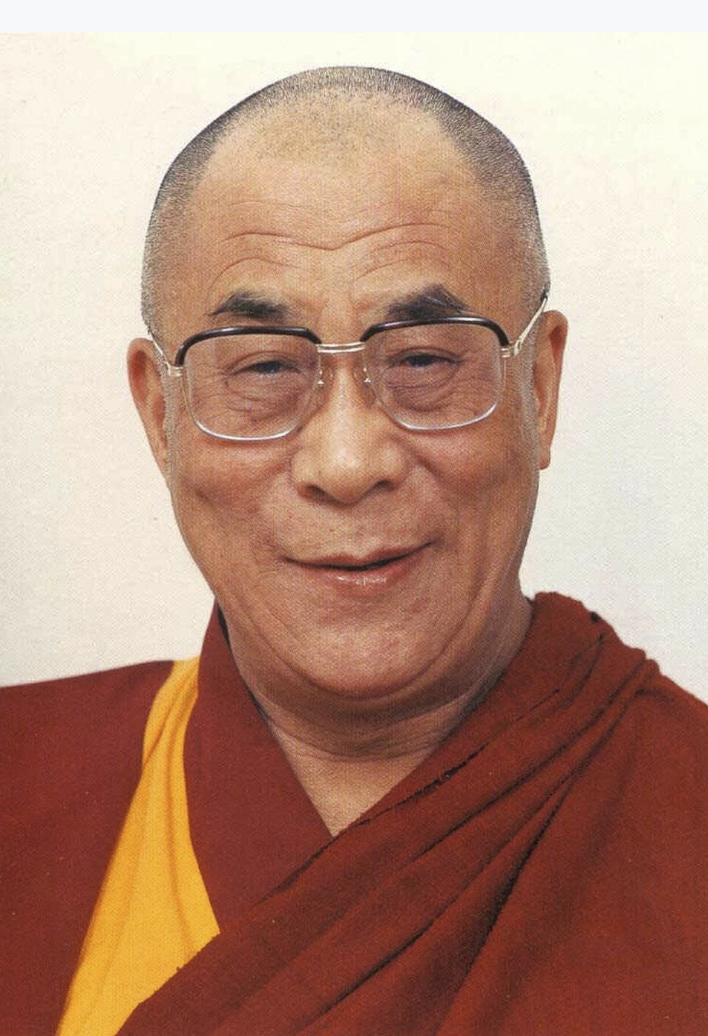
This is the third piece in the Leaning on the Moment series, following the two Joseph Campbell interviews and Tara Tulku, Rinpoche's "A New Dwelling." Here Robert Thurman — the Amherst scholar and translator who has known the Dalai Lama since 1964 — brought a set of questions from Parabola to His Holiness himself, on the subject of "Wholeness": what it means to be a Whole Person, and how the Buddhist understanding of emptiness bears on that wholeness. The conversation took place at the Deanery of Westminster Abbey, where His Holiness was staying as a guest of the Very Reverend Dean and Mrs. Carpenter.
- Roderick MacIver
The Fullness of Emptiness
His Holiness Tenzin Gyatso, the 14th Dalai Lama of Tibet, has a number of principal identities. He is a Buddhist monk in the Order founded by Shakyamuni Buddha around 525 B.C.E. and revitalized by Lama Tson Khapa around 1400; hence, a spokesman for the ancient educational tradition of the Buddhists. He is a reincarnation of the Buddha Avalokateshvara, the Mahayana Buddhist Archangel of Compassion, and especially the Savior of Tibetans, the King of Tibet (tragically in exile for the last twenty-five years); hence, the defender of rights and freedoms of Tibetans. And he is a Vajra Master of the esoteric Mandalas of the Unexcelled Yoga Tantras, especially of the Kalachakra Wheel of Time; hence deeply and perhaps prophetically concerned with the positive evolution of all intelligent life in our sacred environment on this planet.
Dr. Thurman is a professor of Religion at Amherst College, a founder of the American Institute of Buddhist Studies, and an old friend and student of His Holiness's since 1964. This interview was conducted at the Deanery at Westminster Abbey, where His Holiness was staying as the guest of the Very Reverend Dean and Mrs. Carpenter, in the mixture of Tibetan and English His Holiness and Professor Thurman tend to speak when they discuss the Dharma in terms of its relevance to today. Dr. Thurman presented His Holiness with a number of questions suggested by PARABOLA.
ROBERT THURMAN Your Holiness, PARABOLA Magazine would like to ask you about "Wholeness"-the Whole Man, the Whole Person. They say: "We are defining the Whole Person as one who has in his being, to a very high degree, freedom, unity, consciousness, and will. What is your view?"
HIS HOLINESS What I call the human qualities are love, compassion, tolerance, will. To be warm-hearted-that is true human being. You see, not to have warm feeling in the heart, that is almost not to have fully the nature of a human.
R.T. Would you say, finally, that Buddha is Whole Man?
H.H. Yes-on a high level. Yes, certainly. But when I speak of the good qualities of a human being, that means our ordinary human being, on the human level. Buddha is already beyond the human level.
R.T. If Buddha is beyond ordinary human nature, then some people might think of him as cold-hearted-someone sort of superhuman, that doesn't care.
H.H. No, no, no, no. What we call Buddha is warm-heartedness developed infinitely, love perfected. And also infinite enlightened conscious- ness-oh, yes.
R.T. Their next question is: "It has been said that the Whole Person is one who lives simultaneously in two worlds. Do you agree with this, and if so, what does it mean to you?"
H.H. This has different meanings. One: the person himself or herself reaches the highest level, but meantime, remains in world affairs-for the sake of other beings, out of altruism. In that way, "living in two worlds" can be said. Then again, maybe another meaning: a person who really practices well, and as a result, for himself or herself there is no sort of emotion, but equanimity. One is impartial; but in accordance with circum- stances, taking certain action. In his inner world, there are no differences, but in his outer world he or she keeps aware of differences, and accordingly takes action. So you see, two worlds, I think, can be understood om different levels.
R.T. "Is there a fully realized, totally developed whole within every human being? Or does the process of struggling to free oneself of ignorance contribute to the perfecting of the individual? In other words, is there only a seed of a liberated being within, which must grow through effort?"
H.H. I think this is correct. In other words, what we call the Buddha-nature-that is the Buddha seed. That means of course there are different aspects of Buddha nature. One aspect is shunya *: "the reality of the mind which needs not to abandon any taints." That is what we call Buddha nature, according to the Ornament of Realizations. Also, Sugatagarbha: according to the Supreme Tantra, that also is Buddha nature, and the ultimate nature of consciousness is also called Buddha nature: Tathagatagar- bha. So you see, from that viewpoint, the seed of liberated being comes right from the beginning; that seed is there. But that is not sufficient. Just by being there, there's no benefit, right? So you see, one needs effort, to develop, to purify oneself, on the basis of that nature.
R.T. Is it that the fact of that seed being there makes it possible to do it? Without it. . .
H.H. Without it that can't happen. There is no sense in purifying a stone, even though it has the nature of emptiness also. But because the other aspects of the Buddha nature are not there, we can't say that the stone ultimately becomes Buddha.
R.T. "Are human beings, as they are, in any way unfinished?"
H.H. In the spiritual sense?
R.T. Yes, and in the evolutionary sense also, perhaps. Have they reached the fulfillment of their evolution, perfected their brain and heart and understanding, or are they unfinished in that sense?
H.H. In that sense, I don't know. The human brain may develop or it may decrease. I am not at all sure.
R.T. But isn't a Buddha a being with a more developed brain?
R.T. Isn't it? It is not test tube development!
H.H. (Gales of laughter.) I think, you see, without effort, that kind ofevolution we are speaking about cannot take place. For example, first an animal goes on four legs, then on two legs, then it is easier to run around, yes? Now that is without effort, isn't it?
R.T. I don't think it is without effort.
H.H. Not in the sense that, for example, those four-legged creatures needed some effort to go on two legs-that kind of effort, yes. But I speak of evolution in the Buddhist sense: for example, in the primordial eon, beings do not depend on grosser food. Then they go down, and finally
H.H. But that's not natural evolution. reach a ten-year life span. That period is the worst the human race can reach. Then again another rise, and finally they reach the time of Maitreya's teaching. That we may call "evolution." And that without special effort.
R.T. I see what you mean.
H.H. Simply as you see the seasons changing, these are cycles. We are still, you see, on the line of decline ....
R.T. Unfortunately.
H.H. (Laughing.) You can't say unfortunately. That's just the way it is.
R.T. But, an individual who is reborn after an effort in his individual life-for example, one who creates the spirit of enlightenment, who conceives that higher mind-then he advances in evolution, even though he is in a world like this.
H.H. You see, the human level of mental development, of course, is not a finished one-even in the ordinary sense, within our inner state there are still many things to explore. This has nothing to do with religious ideology; this is spiritual. I think some part of the brain's capability may be fully utilized only through deep meditation. But meantime, there are certain things still to be explored in the ordinary way. So from that viewpoint, the human being is unfinished.
R.T. (Laughing.) Does Buddha have more brain, do you think, in his ushnisha ?*
H.H. It is not a question of that. The grosser consciousness depends heavily on particles of matter; so it is the grosser level that has very much to do with the brain. The subtler consciousness is more independent. So the innermost subtle consciousness does not depend so much on the brain. If it did, it couldn't exist without the brain; and you see, in the Buddha state, the grosser mind completely disappears. Luminance, radiance, immin- ence-the three states of the subtle mind-all of these disappear in the clear light, the clear light of supreme innermost subtle consciousness.
R.T. Exactly, exactly!
Now: "What is the realization which the Whole Person enjoys?" Would you say, like Shāntideva, that the more a person is aware of others, the more they approach wholeness?
н.н. Right!
R.T. So in a sense, to a human being, compassion is almost natural.
H.H. Right, right. As I already said, there are many different levels of the Whole Person. For example, one sees a dog beaten by someone; a Whole Man, on a certain level, then feels a certain kind of pain. Although he is not beaten physically himself, yet mentally he feels he himself gets some kind of blow. If one sees a bug killed before one, one feels a shiver of identification.
R.T. Yes. So though people say that human beings are aggressive, like apes, like tigers, would you say rather that the essence of human nature was not aggression but compassion-differentiating him from the animal?
H.H. I think so. I think so. If the basic human nature was aggressive, we would have gotten animal claws and huge teeth-but ours are very short, very pretty, very weak! So that means we are not well equipped to be aggressive beings. Even the size of our mouths is very limited. So I think the basic nature of the human being should be gentle.
R.T. Now PARABOLA asks: "What does it mean to be free and open?" н.н. I understand the meaning of "open" as just like open door: it can open very easily, without difficulty. Then "free," that is also the same.
And as a result of being free and open, the more you receive new ideas, that makes you want to give out more your own energy. That way, I think, each helps the other. The more new ideas come, the more you see the way open for your own expression or thought to go out. That I think is very useful, very necessary, especially these days.
R.T. Don't you think "openness" is a matter of views, primarily—of not what we call "holding one's own view as superior"? For example, a prejudiced person, who thinks he already knows everything, is not exactly open, is he? So in a sense, doesn't "open" mean "free of wrong views"?
H.H. That's right. The more pride, the greater arrogance, then the less open one is. Yes, we do call that holding one's own belief as highest, not accepting other beliefs. Now, there is a different meaning there. The self realizes that our knowledge and our mental development are not fully developed, and feels that there are a lot of new things to be understood; in that sense one is open and free-minded. But there are certain things one nvestigated oneself, for a long time, and found a conclusion, with reason.
On those subjects, you should be very firm. That does not mean you are not open-minded. But since you fully investigated, and you found the firm answer, you accept that as ultimately true. Openness does not mean you are wishy-washy, or that if someone comes and says, "Oh, this is not that," then you change; and another person says the opposite and again you change. It is not like that! Conceit about a view means a certain wrong view of reality, a dogmatic attitude. That is view-conceit. But holding truth as true, without prejudice-there is no pride there.
R.T. "How do you see openness in the sense of the non-obstruction of fe-force?"
Coming back to fanaticism and dogmatism about views, there is the field race-relations: "I am white," "I am black," "I am Chinese," "I am American." For such persons, even some little hints of emptiness might make their views more gentle and temper their fanatic ideology, don't you hink? It might dawn on them that their deepest identity was something beyond their race or nationality.
H.H. Now, here, you see, two things are involved, so we should be very clear. There are two levels of the strong feeling that I am of this race of that race; one, the conventional level-just the mere recognition that "I am an Easterner" or "I am an American," which is true. There is nothing wrong with that. It is reality. In order to make harmony between races, the basis is difference; there are different types, and it is thus harmony comes. The realization of emptiness in no way harms this feeling. Even I think it supports it. Now this is the level of conventional recognition.
Then there is another thing. With this realization, then the other strong feeling, the truth-habit, arises. When that joins this mere recognition, it starts trouble. It is that feeling that becomes racism; the prejudices of the truth-habit are very much involved. Now, the view of the realization of emptiness is quite contrary to that feeling of truth-habit; it is the antidote for that. For example, I see something good; I appreciate it, it's a good thing. Here there's nothing wrong. Then I go beyond that: "Oh, it is very beautiful!" and I become very much attached to it; then there is something wrong. So you see, the view realizing emptiness removes the exaggerated identity feeling on the second level, not on the first level. The first level, if we misapply emptiness on the conventional level of surface reality, then confusion will arise, nothing can be distinguished, then it will go into nihilism.
R.T. Yes; that's very precise. That's great. ...
Now, another question. "I understand your teaching to say that the Buddha nature is inherent in every person. There is also an expression, especially in Zen Buddhism, 'effortless effort,' which is often misunderstood to mean an inner passivity. What kind of active inner effort is necessary for the liberation of the Whole Person within?"
н.н. This "effortless effort" is what is called the effortless striving.
Right. Now in the meditation of mental quiescence, in the nine states of mind, there is a state where striving must be abandoned; an effortless concentration is necessary at a certain stage. It is effortless; that means, your mind becomes very tranquil-with good qualities, with its character complete. At that moment, if you make effort, that disturbs the tranquil-lity. So in order to maintain that pure tranquillity, the sort of effortless effort must be used. Of course, it is a kind of effort. You have to make at least a mental effort: "Now, I don't want to make effort!" That means effort, in order to have less disturbance of meditation.
R.T. So there's a kind of wisdom....
H.H. No, not a kind of wisdom, a kind of concentration. Before this moment, when your mind tends to depression, then you need some effort to raise up your mind, intensify it. When your mind becomes active and ready to go to different objects in distraction, at that time your mind should be quieted. So that effort must be made. When your mind becomes even, with no more fluctuations, you need to stabilize it; that is the effortless effort. That is the simple effort to heighten any tendency to depression, lower any tendency to excitement. It is effortless in the sense of subtly balanced. It has nothing to do with emptiness. Of course you need an active inner effort.
R.T. "Can you explain what is meant by compassion and why it seems so little accessible?"
H.H. Now, our compassion is not just sheer emotion by itself. One must think over some reasons; it comes with reasons; thinking that all beings want happiness, do not want suffering; thinking over such reasons, wishing to free them from suffering.
R.T. Besides, from the Buddhist point of view, is it really "so little accessible"? Isn't it quite accessible for a human being?
H.H. Yes, it's not far away from human beings. Their using compassion depends on whether or not they know how to think it over, how to cultivate it in their minds, or whether they make effort. The key is how to use the mind, how to open the mind through reason, and then make the effort.
R.T. PARABOLA's next question: "Are lower energies to be purified in the sense of removed, or are they to be transformed? In what sense can the lower forces be a help?"
In other words, must the lower energies only be suppressed, or can they be carried into the path and be an actual help, if rightly treated?
H.H. Yes, they can, in some cases. I think the different stages must be considered. The initial, preliminary stage is when the person is not yet much developed in the wisdom field; during that time, the lower energies should be controlled. Then when there is more wisdom power, and also some other technique, then they can be transformed-so that the lower force becomes, instead of an obstacle, a help.
R.T. But if you try to do that too soon…
н.н. Without other factors, then by itself it will not work; it is dangerous. For instance, there are certain very powerful poisons, say morphine, which in certain cases can be used for medicine. Aryadeva, in one of his works, put up a great argument: "The various substances enjoyed in the Tantric practice according to the vows, these things can be used in that practice... for example, poison can be used effectively as medicine. As it helps, it is no longer poison, but medicine. As it helps, it is to be used."
R.T. Now, "What would be a fruitful attitude for me to hold towards those things in myself which I would like to change? Should I hate these aspects of myself? Study them? Try to eliminate them? Learn to accept them?"
H.H. That depends on your own inner strength. There are different techniques. If it is someone who knows, and who has the capability, that is one thing; if not, the only thing is to eliminate. And after all, the ultimate aim is to eliminate these. But the method sometimes makes use of these negative forces; for example, insects born from wood eat the very wood—it's like that. Those persons who are using these lower energies or wrong thoughts-that does not mean they accept these thoughts, only that a different method is being used. It's something like wrathfully killing one's enemy in the open, or using stealth and deception to kill him; in both cases, the essential point is to kill the enemy. In one case, with a very wrathful face, in the other, a very polite one, and then exploiting his own weakness.
R.T. Yes, like judo.
H.H. Exactly.
R.T. Now they ask: "Is there a relationship with one's own suffering which is not usually understood?"
H.H. In Christian teaching, suffering has some powerful meaning, doesn't it? For example, Jesus took the suffering himself. Now that, you see, was not in the ordinary sense, but something very meaningful. Now in Buddhist tradition, we have every right to avoid, to overcome suffering; but when the suffering actually happens, then, instead of being discouraged or mentally distressed, you simply utilize that occasion in such a way that it will benefit you. For the moment, you will minimize your mental disturbance, and for the long run, you develop a certain kind of motivation that will help you to gain more virtue.
R.T. Your Holiness always says that suffering increases your inner strength.
H.H. That is right.
R.T. But some people might think: well, then, I should seek more suffering in order to become stronger.
H.H. (Laughing.) This I don't mean.
R.T. But voluntary suffering-in a way, isn't that what it is? Don't Bodhisattvas sometimes seek suffering on purpose?
H.H. Oh yes, they do. "I want to take on myself all the sufferings of living beings." They directly enter into suffering that way. But in that case, you see, actually the suffering does not come!
R.T. Ahh! Is that so? When they seek the suffering, they don't get any?
H.H. No, never. The wishing for suffering makes the suffering disappear.
R.T. That's beautiful.
Another question: "In light of the plurality of religious traditions living side by side in the world today, many people find it impossible to move wholeheartedly into any one tradition; such is the dilemma of modern Western man. Yet to draw a little from this tradition and a little from that seems too often to lead to a featureless pudding. What advice can you give to those in this predicament?" H.H. What is "pudding"?
R.T. Thugpa—everything boiled down to a mush.
H.H. (Laughing.) Oh, oh, oh, oh. …
At the initial stage, I think there is nothing wrong in taking something from this tradition and other things from that tradition—not necessarily becoming a follower of a particular tradition but simply remaining as a good human being. I think that is possible; not only possible, I think it is good. Then if you want further development, a deeper level—it is like education. On the school level, you learn this subject a little, that subject a little. Then you become interested in one field; then you have to choose one particular subject, and train, and become an expert in that line. In the spiritual line also, when you want to deepen your understanding and your experience, then you should follow one tradition. And develop.
R.T. Yes. I was struck yesterday by your use of the metaphor "spiritual supermarket" to mean something good; I thought it was very beautiful.
Usually people use that expression to mean something bad, but you meant that a supermarket offers many choices, many options.
H.H. Ah-hah! Do they usually think of it as something bad? Why?
R.T. Precisely because of the idea that with a little bit of everything it will become thugpa, a hodgepodge, as in the question. But you turned it around, and I agree with your interpretation, definitely: "supermarket" means you have more possibility, more different kinds of people can get what they need. You're not stuck with the one thing they have in the little village store.
That's wonderful, and it applies here.
Now, "What advice would you give to an ordinary Western man or woman who is concerned about discovering his or her true inner nature?" H.H. I think, to try to get at least sometime, with quiet and relaxation, to think more inwardly and to investigate the inner world. That may help.
Then sometimes, when one is very much involved in hatred or attachment, if there is time or possibility during that very moment, just try to look inward: "What is attachment? What is the nature of anger?" That also is good.
R.T. "What is the proper relationship of knowledge to feeling in one's search for the Whole Person within, and what role does the body play in this search?" In other words, is intellectual understanding helpful at all, or is it just an obstacle?
H.H. Ah, but you see, generally speaking, the intellect is not at all an obstacle for searching inner truth. But certain experiences are reached at certain times without using the intellectual side, simply through a kind of direct feeling; that also is possible, from the Buddhist viewpoint. But usually, reasonings are essential. Nevertheless, when you practice the path of Unexcelled Yoga Tantra, when you cultivate the bliss-void-indivisible samadhi, you don't practice analytic meditation, you proceed by concentrative, non-discursive meditation alone. It's the same with the Great Perfection and Great Soul teachings. Now that does not mean the intellect is fundamentally useless. These are different times and different circumstances.
R.T. Especially during the time of learning and reflection prior to meditation. You can't just proceed on faith.
H.H. That's it.
R.T. So would you say that intellectual knowledge initially is crucial? н.H. Yes. And then in connection with the role of the body, you see, when intellectual work is carried on, the brain and its physical particles are very much involved. So you see usually these intellectual thoughts are a grosser level of mind, which is very much connected with the cell particles.
In a state wherein the grosser mind becomes inactive, then the subtler mind becomes more active, and at that moment the relation of the subtler mind and the body cells is left behind, so at that time the intellectual work is also left behind.
Now there are two ways: one method is the meditation of non-thinking-these are the methods of the Great Perfection and Great Seal.
Through the non-conception practice, one should reach clear light. There are other methods, through tummo heat yoga, through Vajra incantation, through breathing practice and so on. But in every case, in the initial stage, the other factor must be there. Even for the practice of the Great Perfection, it requires renunciation, it requires the spirit of enlightenment. Again now, the intellectual function is indispensable.
I don't know the exact meaning of the word "intellect" in English, but if it is our Tibetan togpa, conceptual thought, then the decision, "I am going to meditate in a thoughtless state," is itself a thought.
R.T. Could one use the simile of shooting a gun? Your sight, aiming at the target, is the concept. To hit the target you must sight accurately, have the right concept. The actual shooting is not a concept; the bullet just goes where it is aimed. So that is the non-conceptual concentration. But of course, the aiming is crucial. Is that a fair example?
H.H. Yes, that's fine. It's quite useful.... Of course, there are still some problems. When we talk of the thoughtless state, we are talking really of a deeper level.
R.T. Yes, of course.
The next question is: "What Buddhist concepts are most misunderstood by Westerners, and what troubles you most about the consequences of this misunderstanding?"
H.H. I think shunya is one of them, and also some Tantric practices; and something like "the blood-drinking deities."
R.T. (Laughing.) Cannibal activity!
H.H. For example, Vajrabhairava, the tutelary deity, is very easy to misunderstand; it really looks like some kind of devil. And one can only slowly understand its function as a symbol of the union of the wisdom of great bliss and voidness after an awful lot of explanations. Otherwise it is very misunderstandable. And sex!
R.T. Yes, certainly; there was a lot of confusion about Tantra based on poorly translated Hindu sources.
H.H. What is troubling is the simple fact of the misunderstanding preventing people from getting the right idea. Some people who don't really know anything and pretend to know a lot about it cause the most trouble. And if it is thought that Tibetan Buddhism is some kind of strange business, this is very harmful to Tibetans, as it makes people not respect their culture and so not defend their human rights, not cry out against their national tragedy.
R.T. Now it is asked: "Are true religious teachings fragile? Is the greatest threat to their potency and vigor from inside or from outside? And if from inside, what are the threats?"
I don't think religious teaching is easy to wipe out, but very difficult. Once it is deep-rooted, I don't think it is easy to destroy. The actual threat comes from the inside. That means, you see, those so-called "religious persons" who do not practice well, do not follow a proper way.
That is the most dangerous, the greatest threat. In our own Tibetan case, there is the outside threat. Of course, it can easily destroy the temples and monasteries, but it is very difficult to destroy the inner feeling. But suppose one Tibetan monk or lama behaves badly, then that can do very much harm. That can really destroy the inner faith, the inner feeling. So the actual threat comes from within. And also, using religion as the instrument for division; that also is a threat. And then I think in some cases, you yourself can have too much attachment to the ideology and lose the basic aim of religion, of helping humankind.
R.T. We come to the last question: "What is the task of the Whole Man, and what fundamental questions are you concerned with in relation to your sojourn on earth?"
H.H. The task of the Whole Man is to help others; that's my firm teaching. That is my own belief. For me, the fundamental question is better relations, better relations among human beings—and whatever I can contribute to that.
. . .
In the same book in which this interview appeared, Leaning on the Moment, Interviews from Parabola, their also appeared the interview of Tara Tulka, Rinpoche. You can read that interview here.
Everything Heron Dance does and offers is summarized here.
Zen Buddhism resulted from the encounter between Buddhism from India and Taoism from northern China. Poetry was an important part of the tradition of the Taoist hermit monks of the Zhongnan Mountains. The Tao Te Ching is the best known of those poems but there were thousands of others written over two thousand years ago. Many are as beautiful and mysterious as the Tao.
Zen Mountain Journal also draws from the poetry of the Zen Buddhist monks of old Japan.
Zen Mountain Journal offers a Taoist journaling practice for those who seek to connect with inner worlds, with the deep silence and peace within. The poems and paintings in these posts are part of a journal now being created by Heron Dance Press. It will be available for preorder shortly.
The Zen Mountain Journal is reader supported but there is no obligation to contribute. If you would be willing to contribute, please do that here.