

Silence, the song's other half.
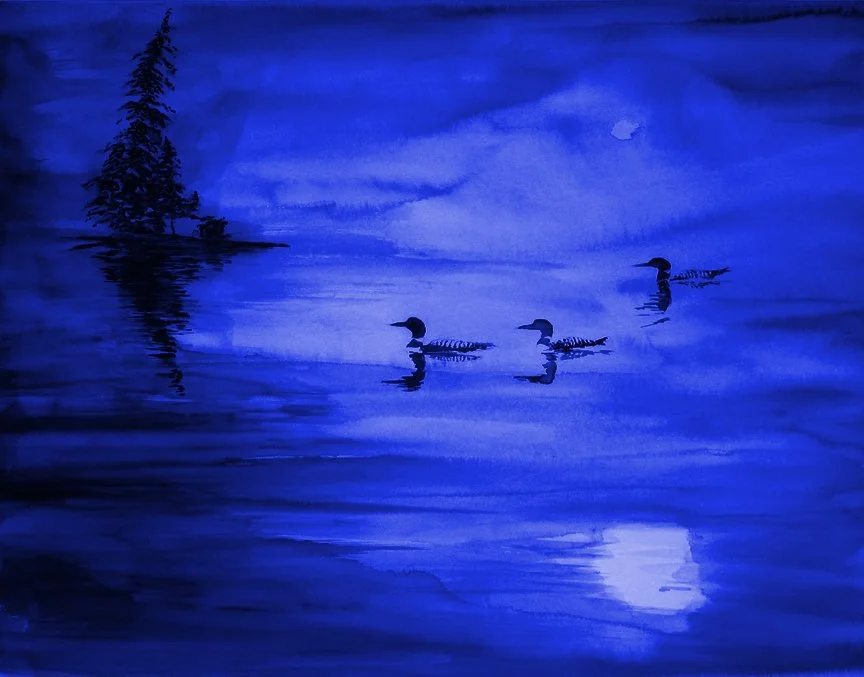
Three Loons
Original sold. Print available,
Contact Rod (rod@herondance.org).
In the last light of evening
The hermit thrush sings
And then waits quietly —
Its song complete.
Silence, the song's other half.
The quest for more creates emptiness.
The one who finds comfort in silence
The one who knows when enough is reached
Finds harmony in simplicity,
Finds harmony with internal realms.
Excess accumulations
Must be defended.
What is sufficient
Rests without fear.
When growth becomes burden,
And possession becomes confinement,
When more subtracts rather than adds
The Tao says rest
And accept things as they are.
The work is finished
When the quiet
inside says yes, this.
It is finished
Just before the mind says
One more.
What endures
is not the excess.
Achievement speaks for itself
Wisdom falls silent,.
- Heron Dance interpretation of the sections of the Tao Te Ching that explore knowing when enough is enough.
. . .
Reflection
The hermit thrush sings its song and waits silently, listening. The silence is the sound of harmony with day’s end.
Our culture is on a constant search for more — more accomplishment, more acquisition, more experience — as if it had an unquenchable thirst. Meanwhile, the Tao Te Ching offers a different way of thinking about life; it is fullest when we know that enough is enough.
The Tao is not about austerity, or grim self-denial. Instead, it is about life abundant, about sitting by a river and listening. When we stop focusing on what we want, what improvements to make, what is left is a beauty and mystery beyond words. The water. The stone. The cold smell of moving current. Nothing missing. Lao Tzu called it "knowing enough". Not knowing enough about something. Just — enough.
One of my major challenges as an artist is stopping when I’ve captured the essence of a landscape or other subject. The tendency is for one more brushstroke, one more revision, one more attempt at perfection. More often than not, when I do that, it leads to another and another and the painting muddies and must be started over or abandoned. I seem to have difficulty accepting that imperfection is fine. A beautiful day can collapse under the weight of adding more and more to it. Rather than enrich, excess obscures and buries.
The world was whole before we arrived, and will be whole after we leave.
. . .
Questions to Consider:
Sit quietly before you write. Take a few slow breaths and let the question find you before you reach for an answer.
Can you recall a moment when something in your life was complete, yet you pushed for “one more”? What was gained? What may have been lost?
Where in your life are you adding out of habit rather than necessity? Where has something already reached its natural completion — but you keep adjusting it, unable to set it down? What are you afraid will happen if you stop?
Think of a time when you experienced genuine sufficiency — a meal, a conversation, a day, a moment in the woods — when nothing was missing and you knew it. What made it possible?
If your inner quiet voice could talk, what would it say is finished right now?
Everything Heron Dance does and offers is summarized here.