

Under the Beautiful and Mysterious Words of the Tao Te Ching, What Is It Really All About?
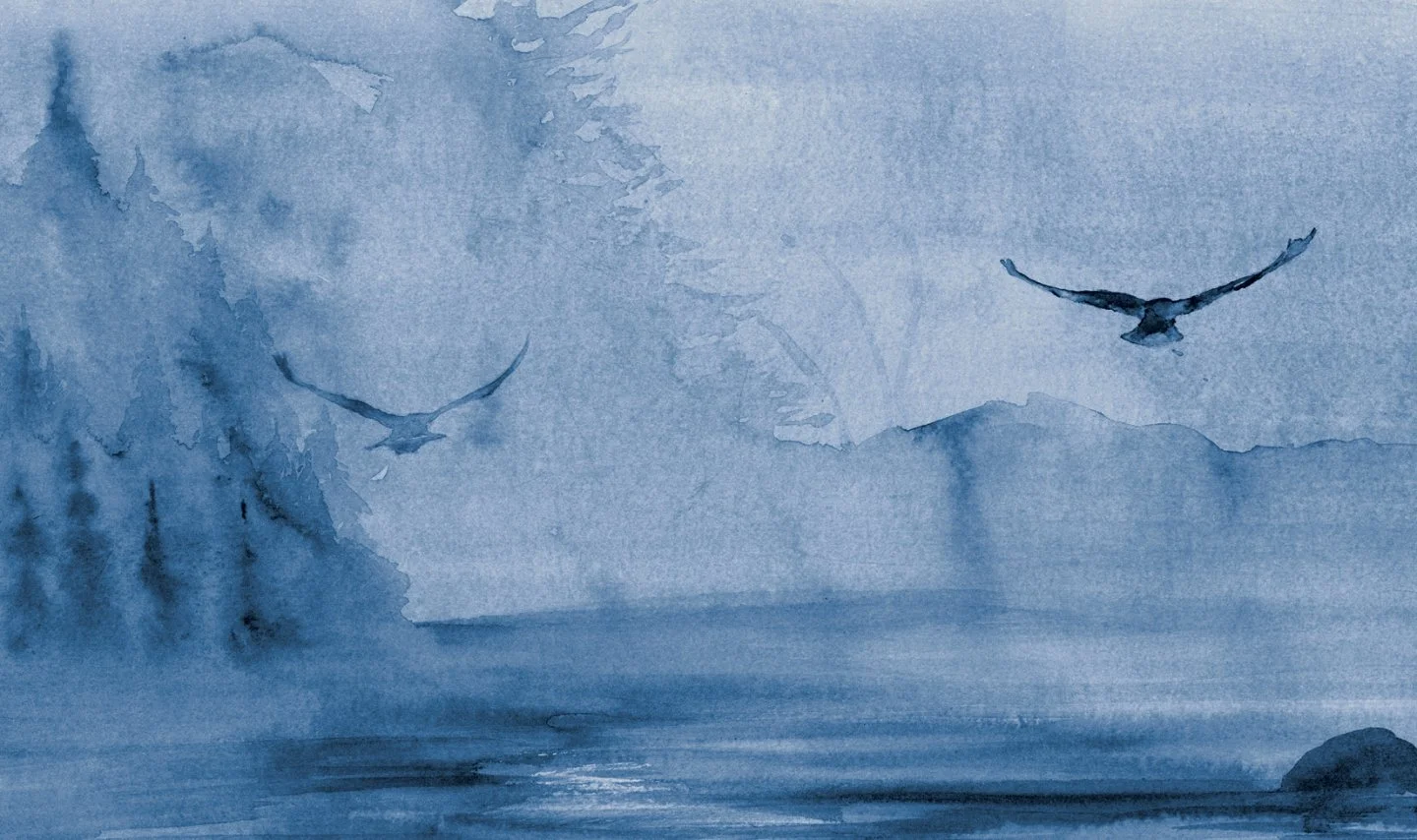
Misty Morning
Original sold. Print available including a framed print for $195.
Contact Rod (rod@herondance.org).
The following is from the draft of the introduction to my upcoming book on using the Tao Te Ching as the basis of a journaling practice. The working title of this book is The Tao Te Ching Journal: A simple path to inner quiet.
. . .
Under the Beautiful and Mysterious Words of the Tao Te Ching,
What Is It Really All About?
The Tao is about harmony. Harmony with yourself, your inner world. Harmony with others. Harmony with the natural world. Harmony with that which is beautiful, which is peaceful. Harmony with the energy flows of the universe: yin and yang.
And it is about listening—learning to hear the quiet voice beneath the noise of daily life and the chattering surface mind. The ancient Taoists understood that wisdom does not shout. It waits. It speaks in stillness. A journal is one of the oldest and most natural ways to enter that stillness, to sit with the quiet voice and let it speak.
Emptiness, stillness, tranquillity, tastelessness, silence, non-action: this is the level of heaven and earth. So from the sage’s emptiness, stillness arises: From stillness, action.
- From Zhuangzi (Chuang Tzu, 4th century BCE)
I first encountered Taoism through two parallel interests—the Taoist hermit monks of northern China and their poetry which was inspired by their lives of solitude in wild nature, and my own extended periods living alone in a cabin back in the Adirondack woods. I also encountered Taoism in my years as a whitewater kayaker. For instance, there was this passage in Christopher Norment’s book, In The North of Our Lives:
Perhaps the best river runners are Taoists at heart. Taoism considers a person wise if he accommodates himself to the rhythms of the universe. Likewise, a boater is wise if he accommodates himself to the river’s flow: He must paddle with the water, not against it. Through practice and sensitivity come an intuitive understanding of the water’s way. One important Taoist principle is wu-wei, which literally means “not-doing.” In practice, wu-wei means letting things be themselves and not forcing them. This does not imply nonaction; rather, there is an understanding of how to take the path of least resistance and apply one’s strength correctly. This principle is embodied in the martial arts of judo and aikido. It is analogous to cutting up a chicken in the best way: Instead of using a dull knife and cutting through the bones, the wise butcher will use a finely honed blade and apply the needed force at the joints. The boater who understands water does not attempt to force his way through rapids, fighting the water and seeking to overcome it. Rather, he applies his strength at the proper moment and in the most efficient way. A light stroke, executed with finesse, will do more to control the craft than any amount of determined but insensitive flailing. The process is explained by Chuang-tzu, a fourth-century B.C. Taoist sage. He tells the story of an old man who fell into a terrible rapid and emerged safely downstream. When asked to explain his survival, the man replied,
Plunging into the whirl, I come out with the swirl. I accommodate myself to the water, not the water to me. And so I am able to deal with it after this fashion… I was born upon the land… and accommodated myself to dry land. That was my original condition. Growing up with the water, I accommodate myself to the water.
This passage is not just about rivers, but something deeper: learning to listen. The rhythms of the water had become the man’s own as he aged. This is what the Taoists mean by harmony—not an idea you hold in your mind, but a way of being you arrive at through patient attention.
Journaling is that same kind of listening turned inward.
. . .
In the Upanishads, the ancient Hindu holy books, there is a passage about two birds sitting in a cherry tree. One bird eats the fruit while the other sits quietly watching. The silent bird is the deep silence in everyone, the quiet wisdom.
Those two levels of consciousness—the busy surface mind, jumping from one desire and fear and disappointment to another, and the quiet mind, the deeper-down flow of consciousness—tend, by their nature, to be out of harmony. The quiet mind, the thoughtful mind, is shy, reticent, unwilling to interrupt the constant chatter of the surface mind. Slowing down requires a deliberate effort. Only then, in quiet, will the deeper quiet voice say what it has to say. The Tao is about accessing that quiet, deep repository of wisdom. It draws from your experiences in life, the lessons learned, and from your dreamworld—the unconscious flow of ideas and thoughts. It can be used to guide and shape our lives and our work. It is that which is holy inside us.
But how do you reach it? How do you still the chattering bird long enough to hear the silent one?
The Taoists developed a variety of practices for this—meditation, tai chi, calligraphy, walking in nature. What these practices share is a quality of unhurried attention, a willingness to be present without forcing an outcome. Journaling can be a valuable tool in this process. When you sit with a journal and let your pen move, you are practicing a form of wu-wei—not-doing, not-forcing. You are not constructing arguments or performing for an audience. You are listening. You are giving the quiet bird room to speak.
Taoism teaches us that wisdom lives in the stillness beneath thought. Journaling is a way to enter that stillness. Taoism teaches that we grow not by forcing ourselves through life but by allowing our nature to unfold, the way water finds its course. A journal is where we witness that unfolding.
. . .
Human beings contain both limitation and vastness; we naturally reach toward the fuller expression. The unconscious is less a repository of what we’ve pushed away or accumulated from the past—it is more accurately understood as the dimension of ourselves we have not yet lived.
Our growth as a person is an inner process much like a giant tree emerging from a tiny seed. Our potential as a creative person, a person who finds and lives a deeper experience of life, seeks to unfold and realize itself. The energies come from within. A human life starts out as possibility—possibilities that shaped by the varied circumstances of life. Through our accumulated experiences and connections, we construct a life and a life story unique to each one of us.
Under the self that lies hidden beneath the social masks and prescribed roles we wear in public life, there exists an authentic core. This core is obscured and hidden under the habitual patterns formed in childhood and in the external influences and pressures we encounter as adults. Over time these patterns come to define us. The protective armor we build—our psychological defenses and ingrained behaviors—serves us in some ways, but increasingly it also tends to constrain and obscure the natural unfolding of who we might become.
Taoists call our authentic core our te—the inner virtue or potency of a thing, the nature that wants to express itself. The acorn’s te is to become an oak. Your te is to become fully yourself. A journal is an invaluable tool in uncovering what that means for you as a unique individual. Our journal helps us uncover and explore what lies dormant within: the potentials waiting to be realized.
. . .
As you work with your journal, be on the alert for questions that make you uncomfortable – the questions you would rather avoid. Some of these “shadow questions” are keys to the new life that lies waiting for you. Don’t ignore them just because they explore counterproductive patterns in your life. These can lead to some of the greatest treasures you will get out of journaling. On the other hand, in this Tao journal, you may encounter questions that are irrelevant to your current life. Ignore them. For this journal to be of value, it can’t be onerous or tedious.
As you use this journal, occasionally go back over what you’ve written and reread it. Record new thoughts that come to mind. When I do that, I find that the thoughts I came up with yesterday, that I thought were important and new, were the same thoughts I had years ago. The fact that they recur, and that I think they are new when they do recur, indicates that they are important and not being given enough attention in my life. This is the quiet bird, tapping at the window again and again.
. . .
To travel your journey—that journey that is yours alone—you need to prepare mentally for the unexpected. You need inner stability, inner peace. You need some toughness. You will get scared sometimes. The ups and downs are greater when you live your adventure. You have to know who you are.
The journey is both about tomorrow and today, about moving toward a vision and being balanced around a center. It is about giving and receiving.
You need a practice or regular routine that helps you stay balanced, because if you lose sight of who you really are, you will be thrown off track, give up, or head off in directions counter to your vision. Taoists understand this. They do not seek wisdom as an abstract goal—they build daily practices that keep them in contact with the quiet current beneath the surface of life. This journal is offered as one such practice.
. . .
I’ve kept journals for more than fifty years. They explore the underlying currents of my life. Throughout the tens of thousands of miles hitchhiked, the thousands of miles paddled, the thousand or more books read, and my experiences fighting forest fires in Canada’s subarctic, living with Dogrib (Dene) Indians, Wall Street, and creating the Heron Dance art journal. Sometimes it seems that the search is a search for a challenge. Sometimes the search is a search for wisdom, for balance and cohesion. A desire to somehow hook into the balance and cohesion of the natural world. Of the universe. And to live in harmony with that wisdom and balance. I’m generally out of sync. But not always. It is an ongoing practice of tuning into the song within and achieve harmony with the creative flow.
My journals have been a friend in down times, a guide at turning points. I also use my journals to record whatever I come across that seems particularly interesting or potentially significant in my life or the lives of those I love. I record passages from books that I’m currently reading, things people say to me that provoke thought and introspection, and just general rambling about the joys and struggles of life.
Looking back on my early years of journaling, I see now that what I was doing all along was a kind of Taoist practice without knowing it. I’ve used meditation and self-hypnosis to quiet my mind before I journal. I sat, and sit, with the silence. I let the pen follow the current instead of forcing it. I listen for the quiet song of the silent bird deep inside. This book, this journaling practice, invites you to do the same.
. . .
Significant efforts are underway to replace the need for donations with art sales from the new Heron Dance Gallery and studio in Asheville, and with sales of the Tao Te Ching journal, now in process. If, in the meantime, this work resonates with you, we need your support. Join us — members who value this work — here.
Everything Heron Dance does and offers is summarized here.