


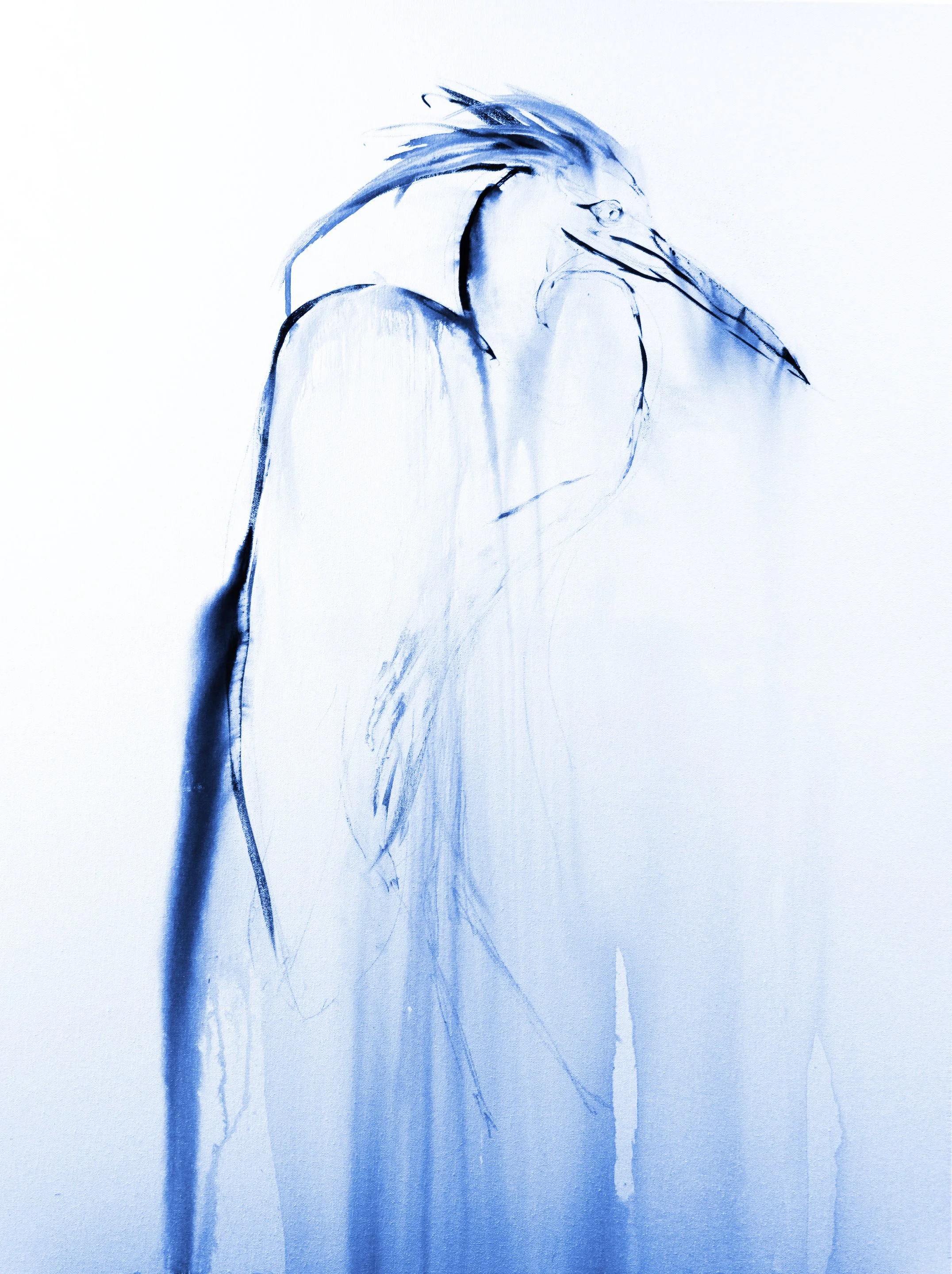
Ziran: Your nature is not a problem to be solved
The heron does not practice being a heron.
It stands in the shallows at dusk
and the whole river bends around it
as though the current had always known
exactly where to place this stillness.
You were not sent here with instructions.
You were sent here as a seed
Unique, ready to unfold in your own way.
Your nature is not a problem to be solved.
It is a current, already moving,
Already knowing its way to the sea.
Reflection
There is a moment on a solo canoe trip — usually around the third or fourth day — when something shifts. You stop paddling with a plan. Your arms find a rhythm that isn’t yours exactly, but belongs to the current, the wind, the weight of the loaded canoe. You don’t decide to enter this rhythm. You just notice, at some point, that you’re already in it.
The Chinese word for this is ziran. It means, roughly, “self-so” — that which is what it is of its own accord, without anything forcing it to be that way. A heron standing in the shallows at dusk is ziran. A river finding its way around a boulder — not because it has a theory about boulders but because it is a river — that is ziran.
In Chapter 25 of the Tao Te Ching, Lao Tzu builds a great chain: humanity follows Earth, Earth follows Heaven, Heaven follows the Tao. And then, at the very top, where we expect some final authority — a god, a law, a cosmic blueprint — he writes: The Tao follows ziran. The Tao follows its own nature. It simply is what it is.
This is one of the most radical statements in the history of human thought, and it arrives without fanfare. Just a quiet observation that the deepest principle in the universe is not obedience, not effort, not will — but the natural unfolding of each thing as itself.
We live in a culture that is suspicious of this idea. We are trained from childhood to improve, to optimize, to overcome our limitations. We treat our own nature as raw material to be shaped into something more acceptable. But ziran says that you were not sent here with instructions. You were sent here as a seed — and the seed already knows what it is becoming. Not because someone told it. Because it is its nature to know.
The journaling practice itself can become a doorway into ziran. Not journaling as self-improvement. Not journaling to become a better version of yourself. But journaling the way the river moves — following the current of your own thought, your own wondering, without correcting it, without editing it into something more presentable. The pen follows the current. The current knows the way.
Questions to Consider
Where in your life are you still trying to be a different species of tree?
What did you know about yourself as a child — before anyone told you what to be — that is still true?
. . .
Everything Heron Dance does and offers is summarized here.
Zen Buddhism resulted from the encounter between Buddhism from India and Taoism from northern China. Poetry was an important part of the tradition of the Taoist hermit monks of the Zhongnan Mountains. The Tao Te Ching is the best known of those poems but there were thousands of others written over two thousand years ago. Many are as beautiful and mysterious as the Tao.
Zen Mountain Journal also draws from the poetry of the Zen Buddhist monks of old Japan.
Zen Mountain Journal offers a Taoist journaling practice for those who seek to connect with inner worlds, with the deep silence and peace within. The poems and paintings in these posts are part of a journal now being created by Heron Dance Press. It will be available for preorder shortly.
The Zen Mountain Journal is reader supported but there is no obligation to contribute. If you would be willing to contribute, please do that here.